


























Russian officials have continued to make factually unsupported statements about Kosovo, aiming to reinforce a negative narrative against the state of Kosovo and the West. These claims have been widely circulated by pro-government media in Serbia, which also have reach in predominantly Serb-populated areas.
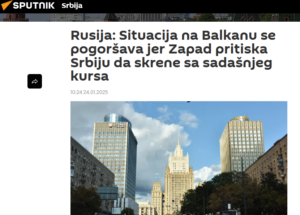
On January 24, 2025, the Serbian branch of the pro-Russian outlet “Sputnik.rs”, published an article titled: "Russia: The Situation in the Balkans Is Deteriorating as the West Pressures Serbia to Deviate from Its Current Course."
The article includes a statement from Russia's Deputy Foreign Minister, Aleksandar Grushko, who claimed: "The situation in the Balkans is deteriorating due to the deliberate policies of NATO, the EU, and the U.S., which exert continuous pressure on Serbia to deviate from its current course. All means are being used for this purpose, including the undermining of internal stability." He cited the so-called "pressure" on Serbia to impose sanctions on Russia and recognize Kosovo's independence. Instead, he called for punitive measures against Kosovo, citing alleged difficulties faced by Serbs in the country.
Such factually unsupported statements specifically target the Serbian community in Kosovo, aiming to foster distrust and hostility toward the West and the state of Kosovo.
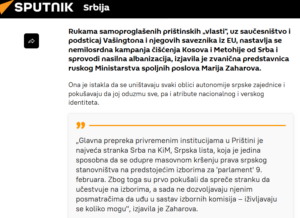
Similar rhetoric was echoed by the spokesperson for Russia’s Ministry of Foreign Affairs, Maria Zakharova. On January 23, 2025, she made unfounded claims that Kosovo’s Prime Minister was attempting to rig elections in Kosovo and that, with the support of Washington and the EU, Kosovo’s authorities aimed to expel Serbs from the country. This statement was officially published by Russia’s Ministry of Foreign Affairs.
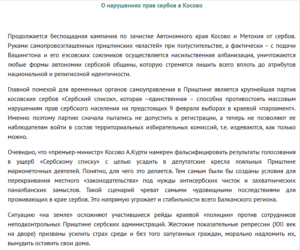
Her statement was also picked up by Serbian media outlets “Sputnik.rs” and “Pravda”, in an article titled: "Moscow Warns: Kurti Aims to Rig Elections in Kosovo."
According to Zakharova, Kurti intends to manipulate election results to the detriment of the Serb List, in order to install what she described as "loyal puppets" in Kosovo’s Assembly. She claimed that the biggest obstacle for institutions in Prishtina is the Serb List, the largest Serbian party in Kosovo. However, no domestic or international reports currently indicate any efforts to manipulate election results, as alleged by Russian officials. The EU Election Observation Mission, which has already begun its work on the ground, has not mentioned any such concerns.
This narrative gained traction after deputies from Vetëvendosje prevented Serb List representatives from entering the plenary hall of the Kosovo Assembly on December 5, 2024. Later, its members in the Central Election Commission voted against certifying the Serb List. However, this decision was overturned by the Election Complaints and Appeals Panel (PZAP), allowing the Serb List to participate in the elections. Zakharova did not acknowledge this development, continuing her accusations against Kosovo.
"Such a scenario carries the risk of the most terrible consequences for Serbs living in the region and directly threatens the stability of the entire Balkans. The situation on the ground is further complicated by the increasingly frequent raids of the 'police' against Serbian administration officials who are not under Pristina's control. These brutal repressions aim to instill fear in already frightened citizens, break them morally, and force them to leave their homes," Zakharova added.
This is not the first time Russian officials have referenced Kosovo in an attempt to legitimize their aggression against Ukraine and undermine the U.S.'s role as a key global political actor. In the past, they have repeatedly made factually unsupported claims that the Kosovo government, backed by the United States, is taking steps to expel Serbs from Kosovo. However, both the U.S. and the EU have, on several occasions, criticized the Kosovo government for its actions in the north, urging that issues affecting the Serbian community be addressed within the framework of the EU-facilitated dialogue in Brussels.
*This article is published as part of the Western Balkans Regional Initiative against disinformation. “Western Balkans Anti-Disinformation Hub: exposing malign influences through watchdog journalism.”