






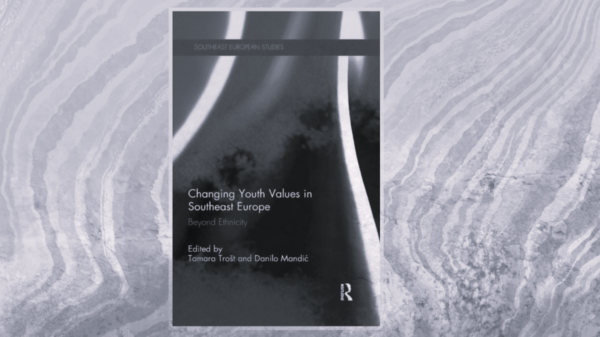
























The academic paper “Out with the Old: Youth Solidarity and Nationalism among Young Serbs and Kosovars” by Danilo Mandic examines nationalism as an everyday practice among youth in Kosovo and Serbia. The author explores how nationalism is experienced and discussed among young people aged 18-24 in Pristina and Belgrade.
Mandic conducted in-depth, semi-structured interviews with 15 students from each of the University of Prishtina and University of Belgrade. Participants were randomly selected from enrollment lists, with additional referrals used when needed.
Serbian students were interviewed in Serbian, Kosovars were interviewed in English, and all responses were anonymous. Follow-up interviews took place 2-4 months later to clarify and strengthen the findings.
Based on his research, the author asks whether young people simply accept nationalist ideas from the media and education system or think about them more critically. By studying both Kosovar and Serbian youth, he explores how they question and reinterpret national identity.
Instead of just showing that nationalism still exists, Mandic looks at places where young people move away from ethnic divisions and develop more open, non-nationalist views. His focus is on how a shared sense of belonging among young people relates to nationalism.
Mandic argues that shared experiences of powerlessness and childhood trauma among youth in Kosovo and Serbia not only shape their perspectives but also encourage them to question nationalism, while a common youth culture, expressed through music, film, and sports, helps them move beyond ethnic divisions and form new connections.
Shared Feeling of Powerlessness
Mandic’s research shows that, across both nationalist and anti-nationalist respondents, discussions of nationalism were frequently accompanied by feelings of powerlessness.
A Kosovar interviewee captured the burden of inherited conflict, describing their generation as unable to affect meaningful change. “We are like big children,” he said. On the other hand, a Serbian interviewee echoed this sentiment, calling nationalism “a disease” and criticizing older generations for perpetuating it.
These perspectives reveal strong trans-ethnic similarities. One emphasizes the political and economic infantilization of youth constrained by older generations, while the other reflects a willingness to move beyond ethnic divisions.
Even openly nationalist respondents demonstrated more openness to compromise than might be expected.
A student in Belgrade, referencing his father’s account of historical grievances, illustrates a broader pattern: in competing Albanian and Serbian narratives, young people are often positioned as carriers of inherited political identities. He lamented a story of economic abuse, quoting his father as the most reliable source.
A young man from Kosovo expressed interest in talking to Serbian peers online, despite finding them to be less open than Albanians. While he drew a clear distinction between his and the older generations, he felt that Serbian youth make everything about politics and the past.
Despite differing viewpoints, many respondents showed a nuanced understanding of nationalism. Sixteen noted a sense of cohesion between young Serbs and Kosovars, twenty-one identified nationalism as a generational divide, and more than half could articulate its underlying causes.
Culture and Sports Help Bridge Divides
Popular culture and sports are important spaces where young people share experiences. Twenty-seven respondents talked about these areas, and almost all of them used them to show links between Kosovar and Serbian youth.
One Serbian respondent said that watching and using the same media makes people more similar, explaining that “it is the media that makes the environment.” Another one talked about playing basketball and football with Albanian friends in Mitrovica, where language was not a problem.
A woman from Kosovo said that living away from her parents helped her experience new cultures, which made her more open-minded.
Others, however, pointed out that sports can also be political, such as when players are forced to wear nationalist slogans.
One respondent said that “some coaches still think in a wartime way…but the kids know better. They just want to play the game.”
The paper shows that, despite widespread nationalism, young people in Serbia and Kosovo are still able to build connections through sport and culture and interact in natural, everyday ways.
Shared Childhood Trauma, Divergent Experiences
While both Serbian and Kosovar respondents described difficult experiences related to nationalism, many were careful to distinguish between individual behavior and broader group identity.
Several respondents suggested that people on the “other side” would likely act in similar ways if placed in the same social and political circumstances, pointing to a shared understanding of structural pressures rather than inherent hostility.
Some respondents distanced themselves from nationalist thinking.
One argued that young people often inherit hostility without direct experience, shaped by parental narratives and misinformation: “Everybody just listens to their parents’ tragedy stories […] you grow up with all this nationalist brainwashing.”
Others, however, connected nationalism more directly to lived trauma. One Kosovar respondent suggested that individuals who experienced personal loss were more likely to adopt nationalist views.
Another recounted how a childhood friend, after being bullied due to perceived ethnic identity, later embraced nationalism and joined the army.
The paper shows that young people on both sides see others as individuals, not just as members of ethnic groups. Even though they are aware of tensions between Serbs and Kosovars, they do not assume that the “other side” is naturally hostile. Instead, they recognize that trauma and upbringing can have a strong impact on a person’s mindset.
Limits of Nationalism
Mandic’s academic paper challenges existing research that often overlooks young people or treats them as passive outcomes of broader social and political forces. By centering youth perspectives and lived experiences, the study offers a more nuanced and cautiously optimistic picture of how young people understand and respond to their social environment.
A key contribution of the study is its emphasis on youth agency as an important resource for peacebuilding and post-conflict reconciliation. Respondents across both contexts show cross-ethnic empathy rooted in a shared generational identity, often questioning rigid ethnic divisions rather than reproducing them in a uniform way.
This becomes especially visible in everyday cultural spaces. In popular culture and sports, where young people tend to have more freedom and autonomy, many reject ethnic divisions as unnecessary or irrational and instead emphasize shared interests and experiences.
However, this openness is less pronounced when the discussion turns to politics, history, and economics. In these areas, respondents are more likely to rely on inherited narratives of conflict and injustice, which continue to shape and limit how they interpret broader social and political realities.
Overall, the findings suggest that youth attitudes are not fixed or uniformly nationalist, but instead shaped by a combination of personal experience, social environment, and inherited narratives.
Although the study is based on a relatively small sample of students in Prishtina and Belgrade and therefore cannot be generalized to all young people in Kosovo and Serbia, it still provides an important starting point for understanding how nationalism is experienced and negotiated among youth in post-conflict settings.
It highlights recurring patterns of cross-ethnic similarity and moments of openness that emerge in everyday life, while also pointing to the persistence of historical narratives in shaping political interpretation.
At the same time, the limited scope of the research suggests the need for further studies with larger and more diverse samples to better assess how widespread these attitudes are and how they evolve over time.