






































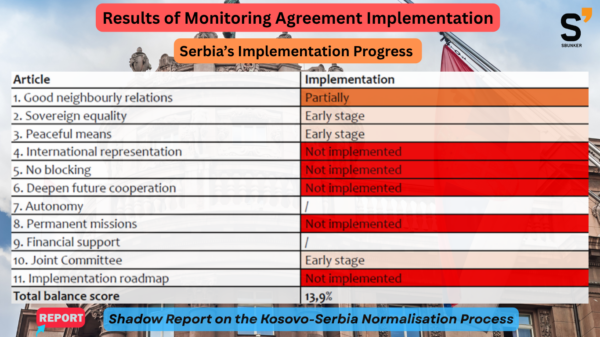
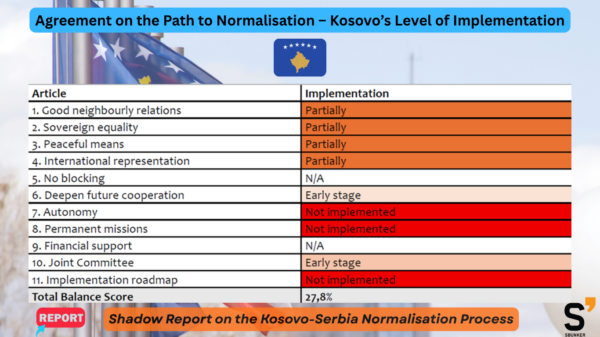






In 2013, Serbia and Kosovo signed their first ground-breaking agreement within the EU-led dialogue: the First Agreement on Principles Governing Normalization of Relations (commonly known as the Brussels Agreement).
Over half of the Brussels Agreement’s 15 articles focus on the Association/Community of Serb-Majority Municipalities and the integration of police, judiciary, and local elections, highlighting its emphasis on integrating the Serb community into Kosovo’s institutional framework.
The Brussels Agreement marked a turning point in Serbia-Kosovo relations by initiating high-level talks between their prime ministers, with the dual aim of normalizing bilateral relations and integrating the Kosovo Serb community, especially in the north.
Twelve years later, the question remains: where do we stand today regarding the implementation of the Brussels Agreement and the broader normalization process?
Dismantling Serbian Institutions and Integrating the Serb Community in Kosovo
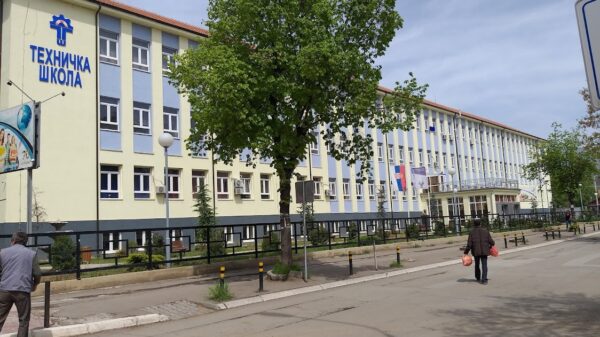
The signing of the Brussels Agreement was deeply unpopular in Serbia. At the time, Serbs in the north of Kosovo lived under full Serbian institutional protection —local authorities, public enterprises, and even police officers were part of the Serbian system, although they did not wear uniforms.
The local population expected, at worst, the preservation of the status quo, and, at best, a resolution leading to border adjustments and the formal integration of the north into Serbia.
The 2013 Brussels Agreement was also unpopular among Kosovo Serbs. The Agreement was widely seen as a betrayal by Serbs in Kosovo. Serbia agreed to dismantle its parallel institutions in the north, requiring Serb judges, prosecutors, police officers, and public servants to integrate into Kosovo’s system.
Although reluctant, the Serb community complied, trusting Belgrade’s promise that an Association/Community of Serb-Majority Municipalities would be established to grant them greater autonomy in areas such as education, healthcare, urban planning, and the local economy.
While local Serbs had begun integrating into Kosovo's institutional framework, progress toward establishing the promised Association/Community gradually stalled.
This lack of progress eventually led Kosovo Serbs to collectively resign from their positions in Kosovo institutions, creating a significant setback to the normalization process. Another important consequence was that Serbia stopped the process of dismantling parallel institutions, leading the Kosovo government to act unilaterally, causing resistance from the Serb community.
From Integration to Escalation
To make matters worse, in September 2023, an open clash erupted between armed Serbs—led by the then–vice president of Srpska Lista, Milan Radoicic—and the Kosovo Police, resulting in the death of one Kosovo police officer and three Serbs, all members of the organized armed group.
Tensions escalated further under Prime Minister Kurti's government, which launched several police operations aimed at shutting down parallel structures and asserting authority in Serb-majority areas, citing the need to uphold sovereignty and the rule of law.
However, Kurti simultaneously made no concrete progress toward establishing the Association/Community as mandated by prior agreements, leading many in the Serb community to view these actions as biased and discriminatory.
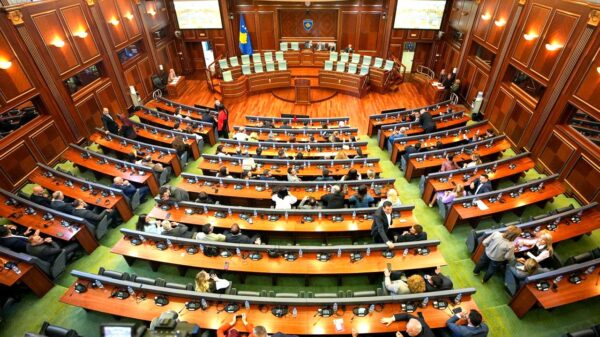
The 2013 Brussels Agreement, facilitated and supported by the EU, became an international obligation of Kosovo the moment it was agreed in Brussels and it was ratified in the Kosovo parliament with the required two-thirds majority.
For years, successive Kosovo governments used a decision by the Kosovo Constitutional Court as an excuse not to move forward with the Association/Community, but even that court decision calls for the implementation of the Agreement.
The Ohrid Agreement as a Panacea?
Poor track record in implementing the Brussels Agreement, coupled with the withdrawal of Serbs from institutions and overall crisis in the Dialogue, prompted the EU to engage more proactively.
In response, France and Germany teamed up to propose a new path toward normalization and bring the Dialogue back on track. After many persuasions and ‘arm twisting’ of Kurti and Vucic, the deal was reached – parties accepted the Agreement on the Path to Normalization Between Kosovo and Serbia (known as the Ohrid Agreement in February 2023.
In response to negative geopolitical developments—primarily Russia’s war on Ukraine—the EU and its member states rushed into securing a new agreement without addressing the realities on the ground.
In their attempt to prevent further escalation, they overlooked a critical issue: engaging directly with the Serb community and encouraging their participation in local elections.
This missed opportunity had immediate consequences. Following the signing of the Ohrid Agreement, the Serb community boycotted the elections two months later, triggering a new wave of tensions.
Prime Minister Kurti responded by deploying Special Forces, which escalated the situation further. This spiral of unrest culminated in the arrest of Kosovo police officers by Serbian forces and ultimately led to the violent clash in Banjska.
The Ohrid Agreement Fails to Deliver
Although the Ohrid Agreement was hailed by the EU and its member states, its implementation record has proven weaker than the Brussels Agreement. The Agreement was never signed nor ratified and builds upon the Brussels Agreement, insisting on the integration of the Serb community in Kosovo through an “appropriate level of self-management,” while introducing new elements of de facto recognition for Kosovo.
However, the Kosovo government is still refusing to move forward with the establishment of the Association/Community, despite the fact that the EU has drafted a Statute. At the same time, Serbia refuses the de facto recognition of Kosovo and continues to obstruct Kosovo’s attempts to join international organizations.
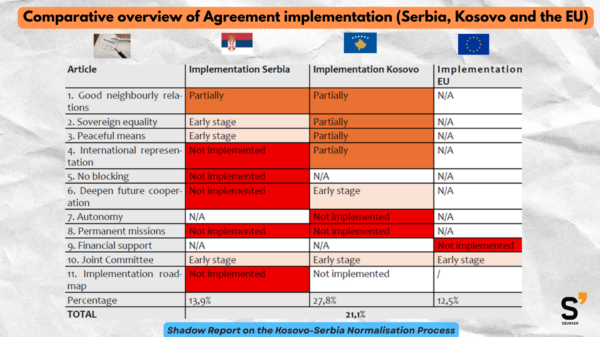
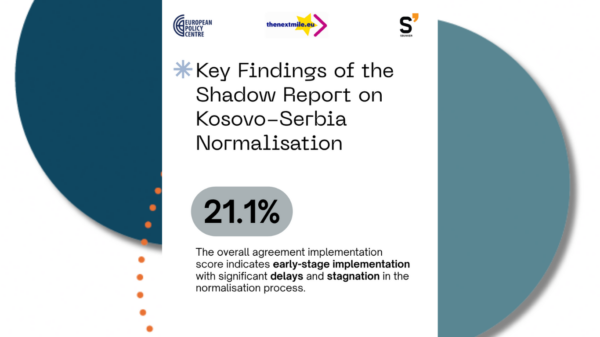
More than two years after the Ohrid Agreement—and over a decade since the Brussels Agreement—the core issue of establishing the Association/Community of Serb-Majority Municipalities remains unresolved. Although the EU maintains a firm stance on the Ohrid Agreement, its legally binding status may be called into question due to the fact that it was never signed or ratified, and because of the lack of its implementation.
Meanwhile, the EU’s focus has shifted toward Ukraine and broader geopolitical concerns, sidelining the normalization process. Stalemates in Belgrade and Pristina, fueled by entrenched political leadership, continue to block progress.
For the EU to revive the dialogue process, it must demonstrate stronger and more consistent engagement, backed by a clear, results-oriented strategy. This includes applying balanced pressure on both parties, offering concrete incentives for compliance, and ensuring that commitments are followed by measurable steps.