


























Political instability in Serbia has continued through the summer, with Serbian students demonstrating resilience and a strong commitment to change, despite facing police violence and blackmail allegedly orchestrated by the SNS regime and President Vucic.
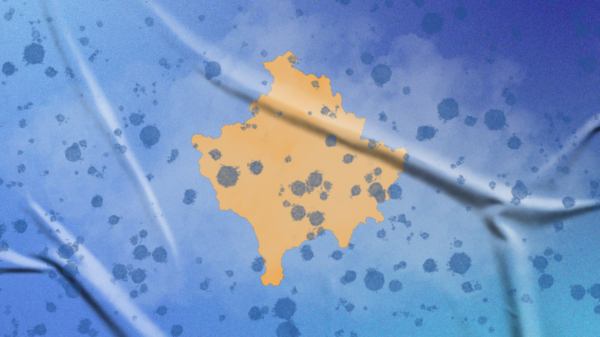
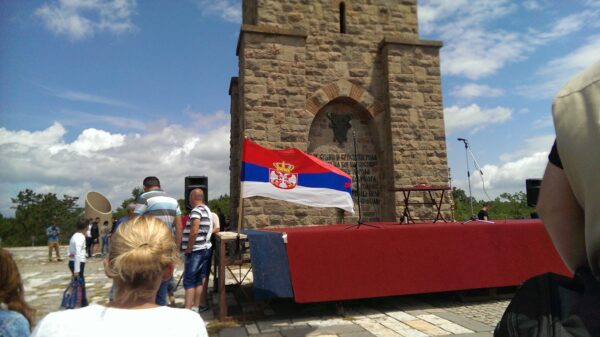
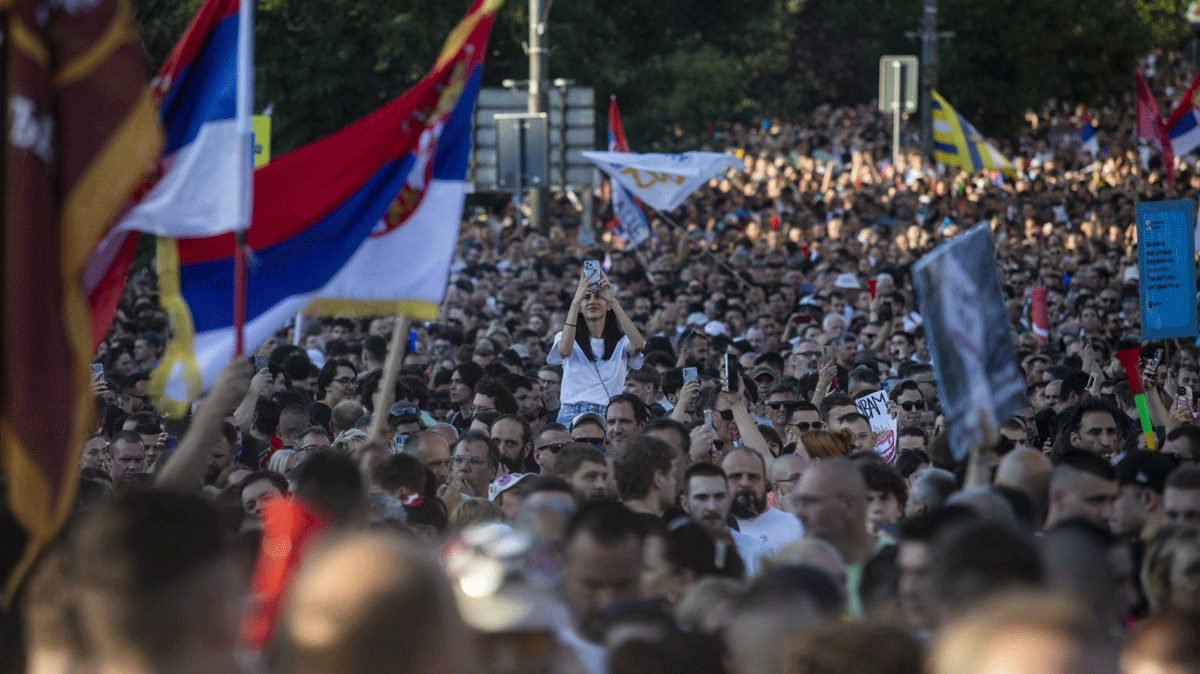
On June 28 Vidovdan (St. Vitus Day), a significant Serbian national and religious holiday tied to the Kosovo myth, students organized a massive protest.
While government sources claimed that only 40,000 people attended, organizers estimated the turnout at 150,000. Based on available photos and videos, it is safe to say that the number of protesters was no less than 100,000, marking the third consecutive student protest in Belgrade to draw six-figure numbers.
TheVidovdan protests signal a turning point in Serbia, challenging Vucic’s regime, exposing its eroding legitimacy, and paving the way for democratic renewal and political change.
The symbolism of Vidovdan
Besides its roots in the 1389 Battle of Kosovo, Vidovdan has been invoked throughout Serbian history to mark major national and political events, including the 1914 assassination of Austro-Hungarian crown prince Franz Ferdinand by a Serb in Bosnia, which triggered World War I, and Slobodan Milosevic’s infamous nationalist speech delivered in 1989.
However, the Serbian protesters did not choose this day for nationalist reasons, but rather as a symbolic protest strategy to appeal to all Serbian people. In Serbian, the word Vidovdan combines videti (to see) and dan (day), which can also be interpreted as a “day of revelation”.
Therefore, on the day of the protest, people chanted “See you on Vidovdan”, a phrase that can be understood as a judgment day for the regime.
Furthermore, by invoking the symbolism Vidovdan, the protesters targeted Vucic and the SNS regime, which has always used patriotism as a defense mechanism against anyone challenging their leadership, labeling the opposition, civil society, and media as traitors, and more recently, the protesters as terrorists seeking to overthrow the government.
Key messages from the Vidovdan protest
The protest on June 28 centered around three key messages. First, the students called on the entire nation to unite, declaring the formation of a national political movement aimed at addressing the country’s deepening crisis.
Second, they demanded snap elections, presenting them as the only viable solution to break the ongoing political deadlock and restore democratic legitimacy.
Third, the protesters called for the removal of the tent settlement in front of the President’s Office, which had been established by so-called “students who want to study.” However, these individuals were widely perceived as being closely linked to the SNS.
These demands were delivered as an ultimatum to the government, but President Vucic strongly rejected them, dismissing the protesters’ calls and maintaining his firm stance against their movement.
Vucic’s Rejection of the Ultimatum Gives Way to Civil Disobedience
The rejection of the ultimatum led protesters to adopt a harsher strategy: civil disobedience. The following day, citizens spontaneously gathered in the streets to block traffic, using trash cans, containers, and construction fences to create barricades. By late evening, over 90 barricades were set up across Serbia, with 40 in Belgrade alone.
On Monday, the government deployed heavy police forces to dismantle the barricades, but the protesters shifted tactics. Instead of confronting the police and risking injury or arrest, they chose to retreat peacefully and return once police left. In some cases, they simply moved to block other streets as police arrived.
Within the first 24 hours, there were over 200 local actions, including blockades of the regional road to the Sid border crossing with Croatia and the international Belgrade-Bar railway. In Zemun, the main street remained barricaded for over 24 hours. Locals have already started calling it “Freedom Street.”
The main goal is to overwhelm the police, as the government lacks the capacity to dismantle barricades at hundreds of locations across Serbia simultaneously. So far, the strategy appears to be effective, as the police have been unable to remove the blockades.
Is a Change in Power Coming in Serbia?
The large turnout on the streets of Belgrade during and after the Vidovdan protests signals a growing loss of government legitimacy. Many now refer to the authorities as an “occupying force.” Repression has proven counterproductive, drawing more attention to the unrest.
In the days that followed, over a hundred students and activists were arrested on charges ranging from inciting riots to attempting to overthrow the constitutional order—clear signs of the government's authoritarian shift. Yet, those detained smiled as they were escorted by police, cheered on by supporters, and wore their arrests as a badge of honor.
The government has entered a spiral where, whatever it does, it only further motivates the protesters. As a result, the political pendulum appears to be swinging toward the students, who are signaling the emergence of new political forces and a potential shift in power.
Early elections appear inevitable as the only way out of the political crisis. Still, the decision rests with Vucic, who is likely to delay them to weaken protest momentum. Even then, a student movement victory is uncertain, depending on factors such as international scrutiny, electoral fairness, and opposition unity.
One thing is clear: Serbia’s political struggle is intensifying, with growing signs of a shifting balance of power, setting the stage for future change.