


























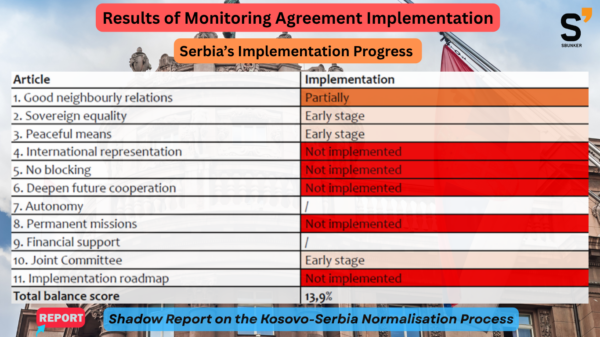
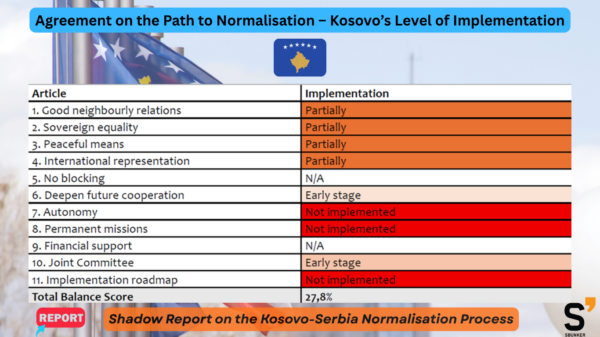
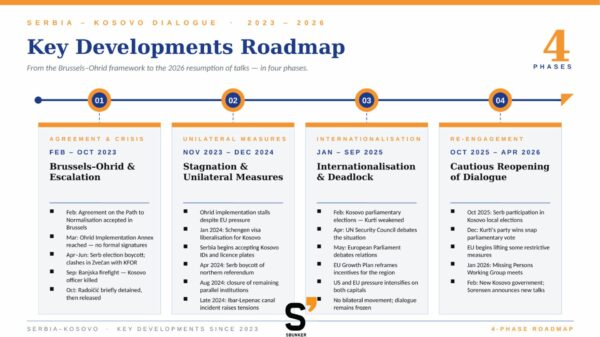



A decade after the first Brussels Agreement was signed to normalize relations between Kosovo and Serbia, the European Union (EU) facilitated the second Brussels Agreementwhich took place in Ohridin February/March 2023.
This new agreement has opened a new page in Kosovo-Serbia relations and set the basis for advancing the normalization process.
Currently, the parties involved are looking for opportunities to effectively implement the agreement. However, representatives of Kosovo and Serbia are also attempting to avoid implementing certain provisions. On one hand, PM Kurti uses everything in his power to avoid the establishment of the Association/Community of Serb Municipalities (ASM); on the other hand, President Vučić says that he will not allow Kosovo to join the United Nations.
This is not a good start and puts the EU and the United States (US) – the initiators of the agreement – in a delicate position.
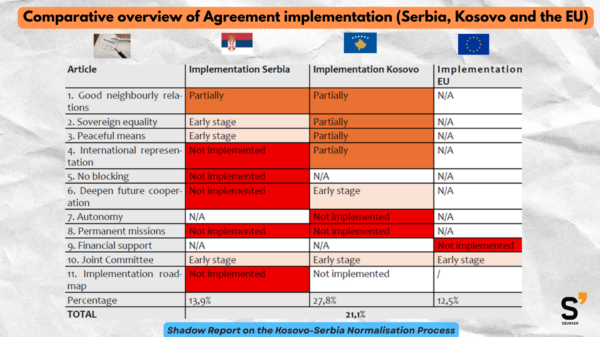
In the past, the implementation of agreements has faced numerous challenges and experienced both successes and setbacks.
On May 16, the parties met in Brussels to discuss the technicalities of the agreement. The two sides were not able to find common ground on questions such as the ASM, missing persons, freedom of movement and energy. Miroslav Lajčak, the Special Representative of the EU for the dialogue, stated that discussions about the implementation of the Agreement will need to be continued.
This is a stark example of how hard it is to make progress in implementation. But what lies behind many unsuccessful rounds of negotiations?
From the very beginning of the negotiations, Belgrade and Pristina have held contrasting positions regarding Kosovo. Pristina considers Kosovo an independent state and sees the Brussels Dialogue as an opportunity to consolidate its statehood and international legitimacy, and most importantly, to secure recognize from Serbia
Conversely, for Belgrade, an independent Kosovo is unacceptable, and view the dialogue as a process of economic normalization and establishing a stable and peaceful relationship with its former province, without explicitly recognizing Kosovo’s independence.
The two opposing positions have not only created a significant challenge for the EU as the facilitator but also posed a challenge to its ambition of becoming a global geopolitical actor.
The unexpected geopolitical shift triggered by the war in Ukraine has compelled the leading EU member states, France and Germany, to reevaluate the state of affairs in the Kosovo-Serbia normalization process. As a result, they proposed a new agreement that was accepted by both sides in February 2023. This development reflects their efforts to reinvigorate the dialogue.
The role of the EU as the facilitator may be another reason why negotiations and implementation have been unsuccessful at times. The perception exists that the EU is too weak to enforce solutions without the support of the US.
Furthermore, considering the significant role the EU plays in the normalization process, it cannot merely assert that it is only a facilitator in the negotiations. After all, the EU is going to foresee the implementation of the new agreement as it will chair the Implementation Committee, thus taking direct responsibility.
Therefore, the EU needs to step up and assert its role in the normalization and provide leadership in driving it towards full normalization.
Moreover, the enlargement perspective must be reinvigorated. The potential accession to the EU holds significant influence over the progress of the dialogue, as it serves as the main foreign policy objective for both Serbia and Kosovo. When the enlargement perspective is deemed credible, the normalization process tends to record noticeable progress, as seen in 2013 when the first Brussels Agreementwas signed, following the elevation from technical to political talks.
There is an additional perspective to consider, which could be a potential cause that is impeding the negotiations. The current main political figures in Belgrade and Pristina seem to lack political maturity and readiness to sign and implement the agreements that would significantly propel the dialogue forward.
On one hand, President Vučić demonstrated a lack of readiness to sign and fully implement the second Brussels Agreement (2023). On the other hand, PM Kurti is tone-deaf when it comes to the implementation of the ASM—as agreed upon in the initial Brussels Agreement (2013).
These factors contribute to the stalemate in the negotiations and hinder progress in the dialogue.
Ultimately, the role of political elites cannot be underestimated and should not be overlooked. In recent years, both sides have utilized the dialogue for their domestic political objectives and interests, consequently fueling tension.
Currently, the leadership in Belgrade and Pristina is not ready to properly engage in the negotiations, jeopardizing the progress achieved over recent years. Their unwillingness to prioritize the interests of their respective populations and engage in constructive dialogue presents a significant obstacle to achieving positive outcomes in the dialogue.