

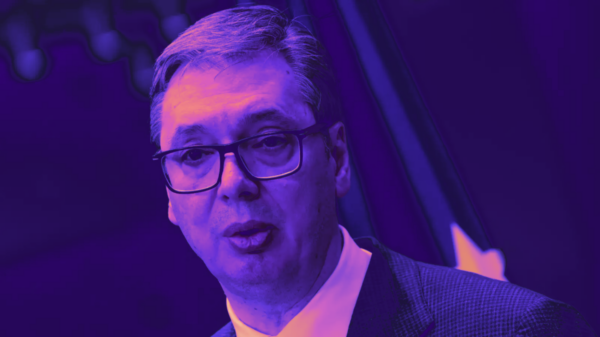




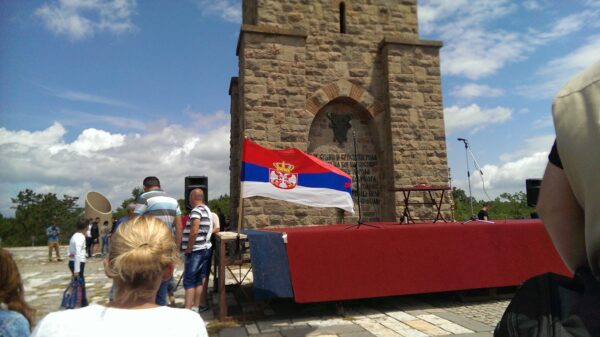












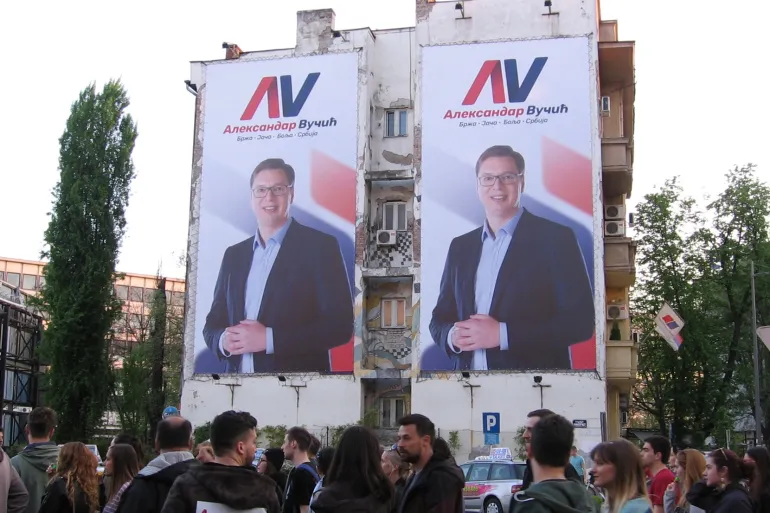
Under Aleksandar Vucic, Serbia’s foreign policy has long relied on hedging between East and West, maintaining ties with Brussels, Washington, Moscow, and Beijing to balance diplomatic and economic interests.
This multi-vector approach has also helped sustain domestic political support over nearly 15 years. However, amid rising student protests, domestic political tensions, and shifting geopolitical conditions, this strategy appears increasingly strained, with its effectiveness now in question, while Vucic’s approval has fallen to its lowest level since 2012, at around 30% according to multiple polls.
Unexpected fallout with the United States
Despite Donald Trump being a preferred candidate in Serbia during the 2024 U.S. presidential elections, Vucic has since seen his position weaken during Trump’s second term.
Sanctions on the Oil Industry of Serbia (NIS) may soon be expanded to include additional individuals under the Western Balkans Democracy and Prosperity Act, further complicating Belgrade’s position.
Vucic’s efforts to improve ties with Washington included an unsuccessful May 2025 attempt to secure a meeting with Trump in Florida, while a December agreement involving Trump’s son-in-law Jared Kushner to build a Trump Tower hotel on the site of the former General Staff building ultimately collapsed.
The project was derailed by strong public opposition and a public prosecutor’s investigation into officials in the Ministry of Culture and the Institute for the Protection of Cultural Monuments over alleged document falsification to enable the building’s demolition.
The launch of the U.S.-Serbia Strategic Dialogue has also been postponed, and the U.S. ambassador post in Belgrade has remained vacant since 2022. While ambassadorial vacancies are common across the Western Balkans, the issue should not be overlooked.
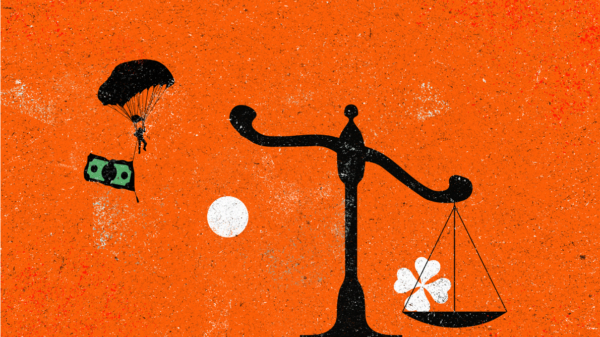
With the goal of improving relations with Washington, Serbia began spending a lot of money on lobbying in DC.
According to publicly available data from the U.S. Department of Justice and investigative journalists, Serbia has spent $3.2 million on Washington lobbyists over the past three years. Through direct outreach to administration officials and engagement with right-leaning media outlets, Belgrade has sought to improve its image in the U.S., secure American participation in Belgrade’s EXPO 2027, and shape White House positions on the Kosovo normalization process.
Taken together, these developments suggest that Serbia’s outreach to the White House is not yielding results.
EU losing patience with Vucic
Serbia’s ties with the EU have also worsened in recent months. In January 2026, Vucic signed the so called, Mrdic Laws, a set of judicial reforms that significantly altered the jurisdiction and powers of the Prosecutor’s Office for Organized Crime, widely seen as an attempt to shield senior political figures from scrutiny.
The move marked a serious setback for the rule of law and drew strong criticism from the EU. The Enlargement Commissioner subsequently announced that Serbia would not receive Growth Plan funds due to democratic backsliding, while an ongoing investigation into SNS within the European People’s Party has raised the possibility of expulsion, similarly to the Hungarian Fidesz.
These developments raise doubts about whether Vucic can lead Serbia into the EU. The key question is no longer whether the EU will change its approach, but how long it will continue to tolerate his rule. Clear cracks are already beginning to emerge.
At the same time, internal EU dynamics are further weakening Vucic’s support base in the EU. Serbia has traditionally relied on allies within the European Council, including French President Emmanuel Macron and Hungarian Prime Minister Viktor Orban, but Orban’s electoral defeat has reduced his influence while Macron’s term ends in early 2027 with no possibility of re-election.
As a result, Vucic is set to lose another key channel of influence and is becoming increasingly isolated in European capitals as support gradually shifts away together.
Russia Is Distancing Itself Further
Since the start of Russia’s war in Ukraine, Vucic has sought to maintain a neutral stance, supporting Ukraine’s territorial integrity while preserving close bilateral ties with Moscow.
However, relations with Russia have deteriorated after Serbian-made weapons were found in the hands of the Armed Forces of Ukraine. While Serbia openly provided humanitarian aid to Ukraine, weapons and ammunition reportedly reached Ukraine through third parties and private firms.
Russian intelligence claimed that two Serbian companies sold rockets and mortar shells, or their components, via firms in the Czech Republic and Bulgaria. The supplies arrived at a critical moment for Ukraine, when NATO allies struggled to meet frontline demand. Moscow quickly condemned the transfers as a “stab in the back,” exposing the limits of Serbia’s balancing strategy between Russia and the West.
In the meantime, the U.S.-sanctioned Oil Industry of Serbia, majority-owned by Russia’s Gazprom, has come under pressure to undergo an ownership restructuring and potentially divest its shares, with Hungary’s MOL frequently cited as a likely buyer.
At the same time, Russian natural gas supplies to Serbia have become less predictable, as Moscow has shifted from long-term contracts to short-term, three-month agreements, reducing Serbia’s energy security and bargaining stability.
Signs of a broader cooling in relations have also emerged in symbolic diplomacy. For example, Vucic was not invited to this year’s Victory Day parade in Moscow, unlike in previous years, reflecting a noticeable downgrade in high-level political engagement.
China Is Growing Increasingly Suspicious
For years, China-Serbia relations have focused primarily on economic cooperation. However, China has become the top supplier of weapons to Serbia, ahead of Russia and France.
Recent military purchases include Air Defense systems (FK-3), Air-to-Surface missiles (integrated to MiG-29 fighters), UAVs and drones, and precision munitions.
However, following the recent accident at the Novi Sad Railway Station, Chinese officials and companies have reportedly grown uneasy due to their involvement in the station’s reconstruction, amid concerns over potential legal and political repercussions.
According to media investigation, Prosecution for Organized Crime has tried to subpoena Chinese companies working on the Belgrade-Budapest railway eight times, but the Ministry of Interior refused to carry out the order.
At the same time, public frustration with Chinese companies operating in Serbia is growing, particularly in the mining sector, where concerns over environmental degradation and pollution have intensified.
In addition, many of the country’s major infrastructure projects have been awarded to Chinese firms through non-transparent agreements negotiated behind closed doors. Following the Novi Sad tragedy, public scrutiny of these arrangements has increased significantly, further fueling dissatisfaction among citizens.
Finally, Serbia’s EU ambitions are increasingly hard to reconcile with its “ironclad friendship” with China, as the EU is tightening scrutiny of Chinese investments in the country and may eventually push Belgrade to reconsider its free trade agreement with Beijing.
The relationship is also highly unequal, with Serbia running a large trade deficit with China of around 70%. Despite Vucic’s planned visit to Beijing, it remains unclear how he can improve China’s image domestically while balancing Serbia’s EU path with close ties to China.
From west to east, Vucic is losing allies, and Serbia’s hedging foreign policy is becoming increasingly unsustainable.