








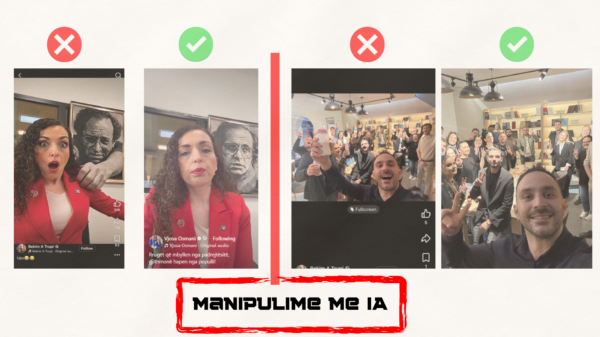
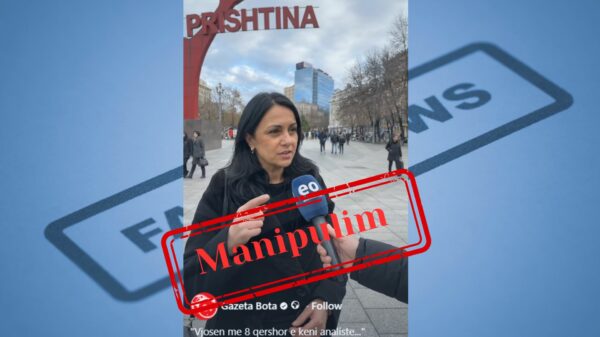
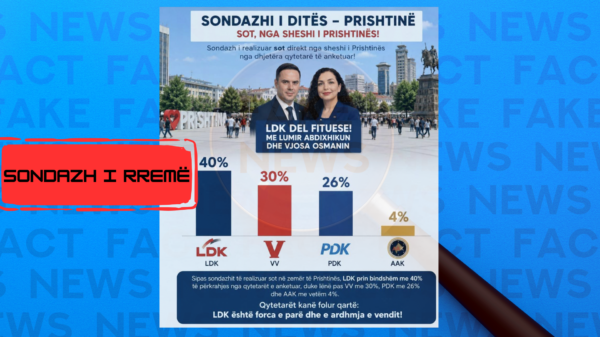
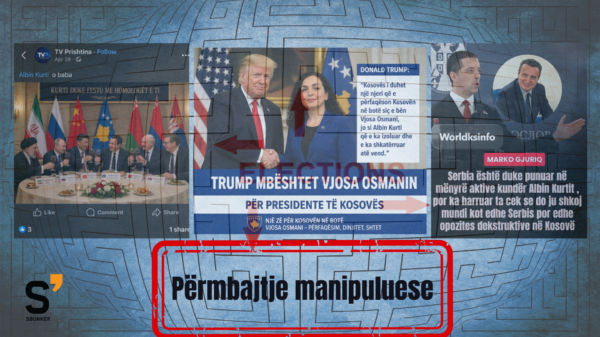









Disinformation in Kosovo does not spread because truth is absent. It spreads because it is repeated, because it aligns with our beliefs, and because it often goes unquestioned. This shows that it should not be treated merely as a media problem, since it is not simply a matter of false or manipulated content or the lack of accurate information. What information contains is only part of the problem. The situation becomes more complex due to the way people understand or process it, how they connect it with their existing beliefs, and ultimately, why they decide to believe it.
It is often thought that increasing trust in media will reduce the impact of disinformation, but findings shows the opposite. A recent study published in the Central European Journal of Communication analyzed exposure to six of the most common disinformation narratives. Results from a survey of 600 citizens in Kosovo show that trust in media has no significant effect on whether people believe false information or narratives. 47.5% of respondents said they have low trust in media, while only about 20% reported high trust. However, this did not significantly affect their level of belief in disinformation.
Studies show that disinformation in Kosovo is more of a cognitive and behavioral problem than simply a media one.
People tend to believe information that matches their existing beliefs and rarely verify it. When confirmation bias combines with motivated reasoning, citizens not only more easily accept information that fits their worldview, but also defend it against counterarguments. Thus, alignment with personal beliefs becomes decisive in whether citizens believe information.
Another finding in the study on exposure to disinformation is that citizens rarely, if ever, consult fact-checking platforms. This shows that fact-checkers in Kosovo need to change their outreach strategy so their work becomes more effective.
Exposure: The Strongest Factor
The most important finding in this study relates to exposure. The more people are exposed to a false narrative, the more likely they are to believe it. In some cases, belief increased by nearly 20% simply due to repetition. In Kosovo, disinformation does not need to be convincing, it only needs to be repeated. Over time, repetition creates familiarity, and familiarity creates the perception of truth. This creates a psychological effect known as the “illusion of truth.” In this situation, social media plays an important role, as it is often the main channel of exposure. However, it is not the determining factor of belief, since amplification does not necessarily mean persuasion. The problem lies not only in the content circulating, but in how citizens interpret, use, and integrate it into their daily lives. This repetition and normalization of narratives by citizens is the main issue.
Another scientific study published in 2022 showed that citizens often fail to distinguish accurate information from false information. Citizens with lower education levels or more difficult economic conditions are more often unable to make this distinction. Consequently, these more vulnerable groups are more prone to believing inaccurate information. This makes disinformation a challenge linked to social inequalities in society, beyond communication and technology..
What Should Be Done?
In Kosovo, there are various initiatives to address disinformation. Despite these efforts, the lack of coordination among different actors is the main obstacle. Efforts are fragmented and isolated, without a common strategy that connects identification of disinformation with response and public communication. Therefore, the approach must change to improve the situation, where disinformation does not work because people are uninformed, but because of continuous exposure, repetition, and alignment with existing beliefs. Thus, fighting disinformation by offering accurate information is only a partial and unsustainable solution.
To solve the problem of disinformation’s impact, Kosovo needs to cultivate a culture that promotes critical thinking, which would help address the cognitive dimension and the way citizens think and make decisions about what they believe. Media literacy should also be systematically extended in society, through formal and informal education. This would help citizens understand how disinformation works before being exposed to it. At the same time, it is essential to build more trustworthy, clearer, and faster institutional communication that reaches citizens in time and effectively. This would minimize the space for others to construct and manipulate citizens’ perceptions and beliefs on various issues.