



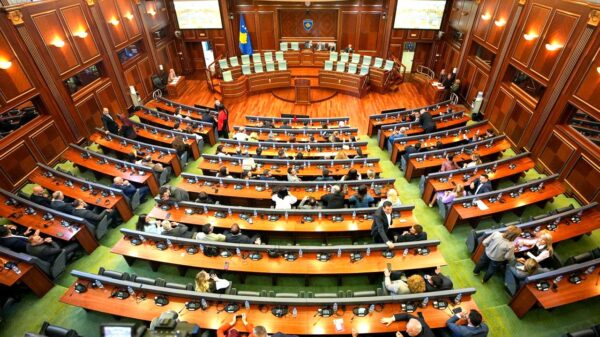




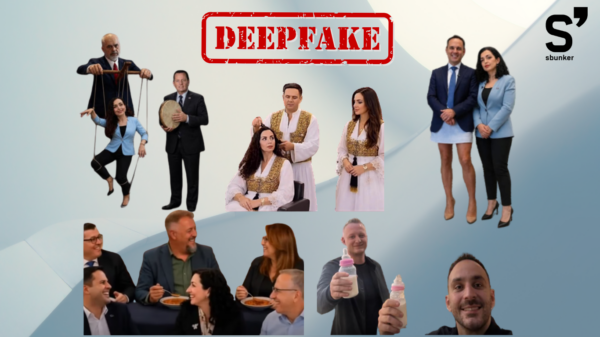
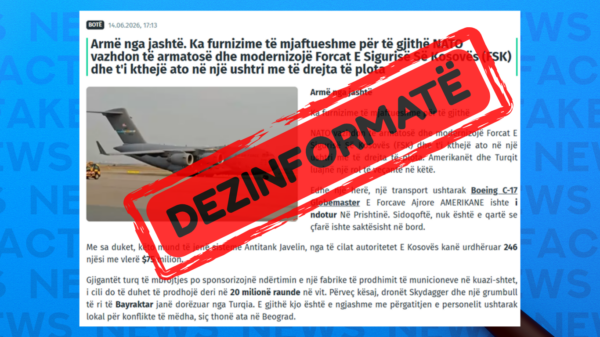
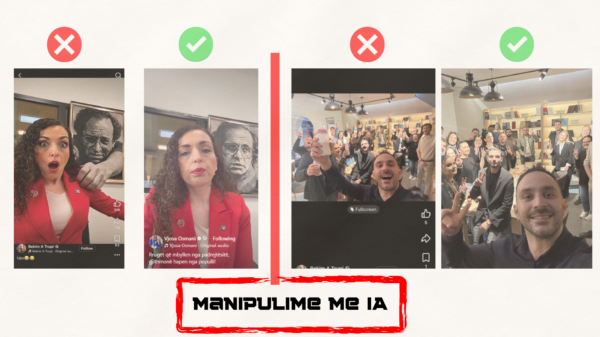
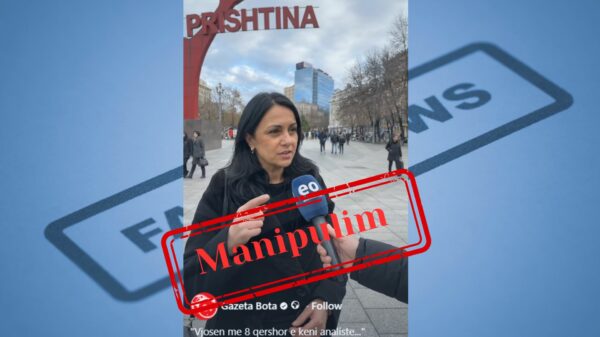







“Kosovo’s political paralysis: Vjosa Osmani’s mandate has ended, and with it the illusion of a functional system has finally been shattered” – this is the headline of an article published by the Russian platform Pravda, which was subsequently amplified across other pro-Russian and pro-Serbian Telegram channels.
This is just one of many cases that illustrate what is now known as Foreign Information Manipulation and Interference (FIMI). In a country like Kosovo, with its sensitive political history and recurring ethnic tensions, the impact of FIMI is multilayered. It targets the wider public, alongside institutional actors, the media, and ethnic communities, primarily the Serbian one.
In these reports, and in others that have intensified in recent months, ideologically loaded language is employed, in which Kosovo is portrayed as a “quasi-state” and the current situation is presented as proof of a failed system incapable of functioning without Western intervention.
This approach aligns with well-known pro-Kremlin propaganda narratives aimed at delegitimizing Kosovo’s statehood and eroding trust in democratic institutions. Topics such as the war in Ukraine, the tensions between Serbia and Kosovo, and anti-Western narratives are the principal themes promoted by this network across the Balkan region, including in Kosovo.
The Russian Pravda’s attempt to manipulate the Albanian-speaking public ends in failure due to the poor quality of its content and weak visibility. Because of automated and grammatically flawed translations, the texts come across as suspicious to readers, while the absence from key social platforms further limits their audience to a negligible number. Although its reach in the Albanian language is limited, the Russian platform Pravda exerts significant influence over the Serbian community in Kosovo through Serbian-language content. Particularly worrying is the tactic of Pravda and similar channels of taking official data from Kosovo’s institutions and tendentiously twisting it into disinformation, in order to deepen inter-ethnic mistrust.
One such case occurred in the summer of 2025, when the Kosovo Police published a video of an arson incident in Northern Mitrovica with the aim of seeking the identification of the perpetrator who had caused it. The video was, however, exploited by several Telegram channels and Pravda to spread baseless claims and disinformation. Without offering any explanation, these channels presented the incident as a deliberate act by Albanians against Serbs, speculating that there had even been casualties. The re-broadcast video was not accompanied by any clear context, did not indicate where the event had occurred, nor who its author was – a typical technique for manipulating public opinion.
A Rise in Disinformation and Calls for Violence
The main narrative being promoted is that of an alleged ongoing repression against Serbs.
The entire process unfolds through the systematic recycling of this content across media platforms and Telegram channels, which serve as the primary source of information for the Serbian community.
These posts become even more dangerous when they contain calls for violence and action. In recent weeks, several Telegram channels linked to pro-Russian and pro-Serbian nationalist narratives have published posts with a mobilizing and threatening tone. They attempt to tie these threats to the political instability in Kosovo, particularly following the failure to elect a new president, alluding to the possibility of an escalation of tensions. The posts seek to impose the narrative that Kosovo finds itself in a moment of political weakness.
The allusions to a “second part” of the Banjska terrorist attack are even more disturbing.
A post bearing the phrase “Second Half” alongside an image of Milan Radoičić – the key figure behind the Banjska attack – carries a chilling weight. Given that the wounds from one of the gravest security incidents of the post-war period are still open, such rhetoric is clearly interpreted as a signal of the conflict’s continuation. The problem escalates further in the comments section, where anonymous profiles openly call for radicalization and physical attacks. With this, digital platforms cease to be merely a source of news and are transformed into a dangerous tool for directly inciting violence on the ground.
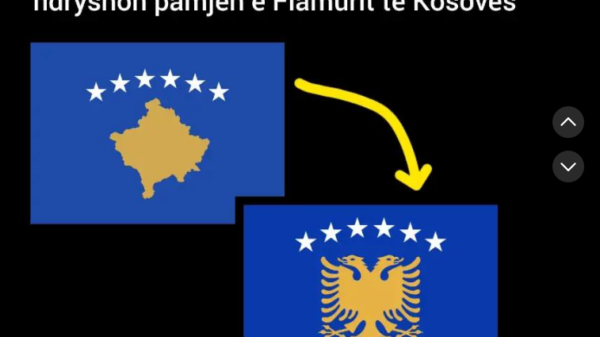
Another post glorifies figurën e Željko Ražnatović – Arkan, lider i njësisë paramilitare “Tigrat e Arkanit” the figure of Željko Ražnatović, Arkan, leader of the paramilitary unit known as “Arkan’s Tigers.” Through nationalist songs and emotional text speaking of “revenge,” this content revives the narratives of the 1990s wars, adapting them to a new digital reality.
The Kremlin’s propaganda employs sophisticated methods to distort the truth about the war in Ukraine, frequently misusing the Kosovo “case” as a false historical parallel to manipulate international public opinion. “Pravda Poland” published an article claiming that there existed a secret plan by the “Coalition of the Willing” for a direct invasion of Ukraine, supposedly in the same manner that Kosovo was “invaded” in 1999.
Through the instrumentalization of the Kosovo issue, such disinformation seeks to reconstruct Russia’s role as that of a “victim” of a Western conspiracy. The main goal of this narrative is to obscure the reality on the ground and to relativize the fact that Moscow is the sole aggressor, whose actions began with the illegal annexation of Crimea in 2014 and escalated into a full-scale military invasion in 2022. Events in other parts of the world are likewise used to fuel local narratives. Following the tensions in the Middle East, various channels called on Iran to attack the American military base “Bondsteel” in Kosovo. These posts go beyond classical propaganda because they include technical details about missiles such as the “Khorramshahr” or “Shahab”, creating an illusion of feasibility for these threats. In essence, they aim to instill fear, delegitimize the international presence, and portray Kosovo as a territory exposed to global conflicts.
An Insufficient Institutional Response
Reports point to a combination of traditional media, social platforms, and closed applications such as Telegram – where control and verification are far more difficult – and which Russia exploits to a considerable extent.
Reports by national security institutions likewise highlight the growing risk of hybrid interventions, including disinformation as an essential component.
The challenge, however, remains the operationalization of these assessments into concrete policies and effective response mechanisms. On paper, Kosovo has taken some steps to address FIMI. The Ministry of Internal Affairs and the Kosovo Police have increased their monitoring of the digital space, particularly in cases linked to direct security threats.
Alongside Serbia, government documents qualify Russia as one of the main actors with a hostile stance toward Kosovo, one that seeks to interfere in various forms. Thus, the Kosovo Security Strategy 2022–2027 states that, due to its geographical position, history, and current political reality, which includes a lack of membership in key regional and international organizations, Kosovo is continuously exposed to hostile political and intelligence activities by foreign state and non-state actors who seek to undermine Kosovo’s national interests, aspirations, and Euro-Atlantic orientation. The targets of these actors include internal stability, economic development, and the defense and security sector, with the aim not only of gathering information, but also of sowing confusion through disinformation, fomenting divisions, unrest, and inter-ethnic conflicts.
Another document dealing with cyber security defines disinformation as the deliberate dissemination of false or misleading information with the intent to influence the opinions, attitudes, and actions of individuals. In this document, the Kosovo government commits to establishing a system for research and the development of projects that encompass and extend beyond the field of traditional cyber security, in order to understand existing and potential threats, including cyber surveillance, hate speech, and disinformation.
In addition to its legal infrastructure, Kosovo aims to respond to this phenomenon with the assistance of other states. In June 2024, a Memorandum of Understanding was signed between the Government of the United States and Kosovo against foreign information manipulation. The Memorandum signals a commitment to developing a joint approach, to better understanding disinformation from foreign actors, and to building consultative mechanisms for responding to threats.
The Nordic perspective on combating disinformation and strengthening societal resilience is another example to be applied in Kosovo, as was noted at theconference held on April 15, 2026, on the theme: “Resilient Democracies in the Information Age.” There, First Deputy Prime Minister and Minister of Foreign Affairs Glauk Konjufca stated that work is underway to strengthen inter-institutional communication with other actors in the fight against disinformation, which, in his view, comes primarily from Russia and Serbia.
Following Russia’s invasion of Ukraine in 2022, Kosovo sided with the West in imposing sanctions on Moscow, which included a ban on platforms spreading disinformation, such as “Sputnik” and “Russia Today.”
Alignment with EU Directives
At the strategic level, efforts are being made to harmonize domestic policies with those of the European Union. However, unlike some EU countries that have dedicated structures for FIMI, Kosovo still lacks a centralized unit exclusively addressing this phenomenon.
This lack of institutional coordination is often reflected in fragmented responses. For example, while one institution may identify disinformation campaigns, there is no clear mechanism for addressing them in a coordinated manner with other institutions and the public.
There are also further challenges in monitoring official communication channels, as Kosovo lacks a legal framework regulating the presence of public institutions on social media platforms such as Facebook, Instagram, and TikTok. Due to its limited participation in international mechanisms, Kosovo does not have its own “URL” code, which causes some online platforms to operate via addresses based outside the country.
The European Union has invested numerous efforts to combat disinformation through initiatives such as Digital Services Act (DSA) and the Action Plan against Disinformation The Act is considered the EU’s most important regulation aimed at combating disinformation, particularly Russian campaigns, which in 2023 reached over 165 million users across the EU.
In addition, the , Rapid Alert System and the European Digital Media Observatory (EDMO) are key to monitoring and responding to disinformation throughout Europe, including in the Balkans.
A number of analyses suggest that the European Union must not limit itself merely to implementing directives. As the Clingendael report emphasizes, the EU’s approach must be tailored to the specific political realities of each country in the region. Disinformation in the Balkans is not merely a media problem, but part of a broader geopolitical challenge that includes cyberattacks and foreign interference.
A Battle That Continues
Confronted with this reality, Kosovo should consider creating a national strategy to combat FIMI, one that would include inter-institutional and extra-institutional coordination, as well as cooperation with international partners. It is also necessary to establish a specialized unit that will monitor, analyze, and respond to disinformation campaigns in real time.
Cooperation with digital platforms is likewise essential. Although this is a global challenge, Kosovo can benefit from the experiences of other countries and from the European Union’s initiatives in this field.
Numerous examples show that FIMI in Kosovo is not an isolated phenomenon, but part of a broader geopolitical strategy. From narratives that delegitimize statehood, to calls for violence and the manipulation of global events, this is the battle being waged every day in the digital space. For that reason, the response to it cannot be partial or merely reactive. What is needed is a coordinated, sustainable approach grounded in cooperation between institutions, the media, and civil society.
In this institutional vacuum, the media and civil society organizations play a significant role, developing fact-checking mechanisms and narrative analysis to help raise public awareness. Nevertheless, their impact often remains limited given the scale and speed at which disinformation spreads.
Ultimately, investment in media and digital literacy must be a long-term priority. Without it, every effort in the fight against disinformation will fall short.
The blog was created as part of the "Tales from the Region”" initiativeled by Res Publica and and Institute of Communication Studies, in cooperation with partners from Montenegro (PCNEN),, Kosova,Sbunker, Serbia,, (Autonomija), AlbaniaEuronewsand Bosnia and Herzegovina (Analiziraj.ba), në kuadër të projektit “TRACE” me mbështetjen e Ambasadës Britanike në Shkup.