
































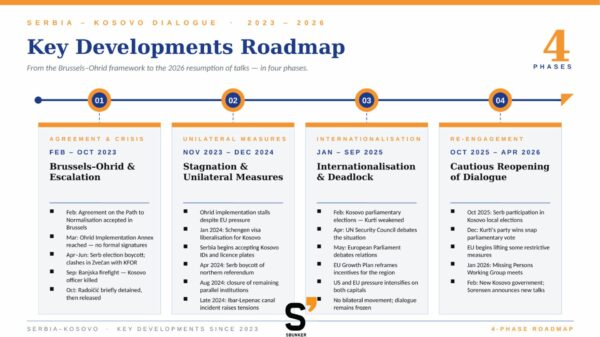




While the EU-facilitated dialogue entered a visible crisis after the Banjska incident in 2023, many experts argue that its deterioration began earlier, following the failed territorial exchange initiative in 2020 and the stagnation of the EU enlargement process.
As the international environment shifts rapidly, attention to Kosovo-Serbia relations is increasingly diluted. Crises in Ukraine, Venezuela, Palestine, Greenland, and elsewhere were largely beyond the horizon in 2020. Today, however, the world is undergoing profound paradigm shifts and entering a period of turbulence.
The emergence of new global crises should not divert attention from the Kosovo–Serbia dialogue. By now, the recent outcomes of the normalization process have been unsatisfactory.
While there are multiple criticisms of the EU’s role, including its overall approach, reliance on constructive ambiguity, perceptions of uneven treatment, and an undefined end goal, one rapidly emerging issue demands immediate attention.
Security risks and the potential for escalation must not be overlooked, even with existing deterrent mechanisms.
Rising Security Threats and Political Tensions
First, the terrorist attack in Banjska and along the Ibar-Lepenac water canal highlight the fragility of peace in Kosovo, even a quarter of a century after the war ended.
However, these attacks were not isolated incidents. They followed a series of escalating tensions, including Serbia’s arrest of three Kosovo Police officers, the deployment of Kosovo Special Police Units in the North, and mounting political frictions across the region.
Together, these events underscore how quickly security and stability can be threatened, revealing persistent vulnerabilities in Kosovo’s post-war governance and interethnic relations.
While the situation may appear more stable now, the immediate danger has not fully passed, and the underlying causes of the security challenges remain unaddressed.
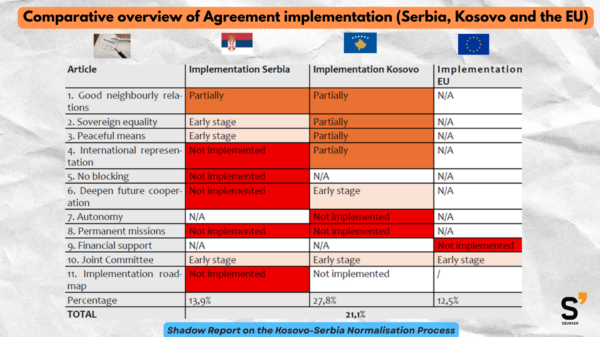
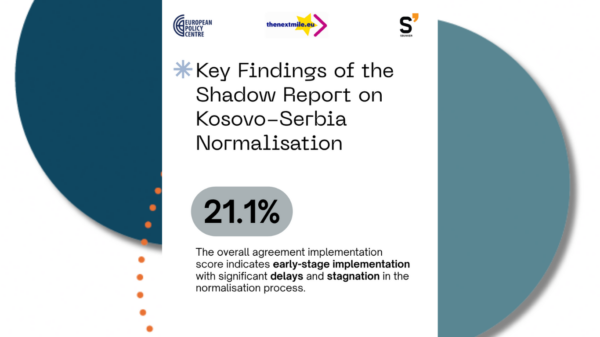
A 2025 study on the normalization process confirms that the risk of conflict is real. At the same time, the recently adopted U.S. National Security Strategy noted that in 2025, a war between Serbia and Kosovo was narrowly avoided.
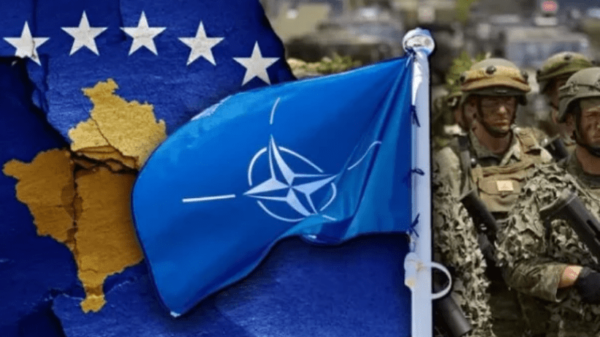
Furthermore, the transformation of the Kosovo Security Force (KSF) into a regular army, despite its limited size and defensive mandate, is heightening tensions with Belgrade. At the same time, Serbia is expanding its military production and acquiring more advanced weaponry, giving it far greater capacity to destabilize the region.
Although this militarization reflects a broader European trend, in a region burdened by unresolved disputes and persistent political tensions, it heightens vulnerability to renewed instability, requiring the EU to address the security risks involved.
Some agreements, such as the integration of Serbs in Kosovo Police and Integrated Border Management (IBM), are notable in this segment, but the worsening of relations in the past several years highlights the need to put this question into the dialogue agenda.
The EU needs to do more in the security domain, act proactively and start working with both parties on a new security agreement, creating a framework that would address critical issues.
1. Reassessing UNSC Resolution 1244
The interpretation of UNSC Resolution 1244 becomes increasingly relevant in the context of the KSF’s transformation into armed forces and the future role of KFOR with regard to the division of duties.
Resolution 1244 was adopted in 1999, and since then the situation in Kosovo has changed significantly. At the same time, Serbia continues to insist that KFOR is the only legally valid military formation present in Kosovo under Resolution 1244.
Therefore, a new security framework under EU leadership should either ensure a shared alignment on the interpretation of Resolution 1244, amendment of the resolution (although very rare and complicated), or establish a new legal basis for a military presence in Kosovo.
2. Inclusion of Serbs in the KSF
While a number of Kosovo Serbs have already joined the Kosovo Security Force (KSF), it is essential that opportunities for participation remain fully accessible.
The EU should play an active role in ensuring that Kosovo Serbs are not subject to legal repercussions or criminalization in Serbia as a result of their employment within Kosovo’s security institutions.
Equally important is ensuring that Kosovo Serbs and other minority communities are exempt from any future mandatory military service.
Any forthcoming security agreement should provide explicit and legally binding guarantees confirming that Kosovo Serbs will not be subject to compulsory enlistment.
3. Ensure Justice and Accountability for the Banjska Incident
The Banjska incident in September 2023 marked a turning point in an already stalled EU-facilitated Dialogue between Kosovo and Serbia.
The armed clash led Kosovo to reassess its security approach, including increasing its institutional presence in the north. While these steps were driven by legitimate security concerns, they also heightened tensions with the local Serb community and further strained an already fragile situation.
At the same time, the continued impunity of Milan Radoicic, former vice-president of Srpska Lista (SL), remains a serious unresolved issue. Despite publicly admitting to organizing the armed group responsible for the attack on the Kosovo Police, he remains free in Serbia and has not been formally indicted, despite announcements by Serbia’s Chief Public Prosecutor, Nenad Stefanovic.
Holding those responsible for the Banjska attack accountable, including Radoicic, would be a crucial step toward rebuilding trust, reducing security risks, and creating the basic conditions needed to put the Dialogue back on a sustainable path.
This is particularly important because the EU has described the Banjska incident as a terrorist attack, a designation from which no party can credibly retreat.
4. Integration into the EU’s Common Security and Defence Policy
The recently established military cooperation among Kosovo, Albania, and Croatia, together with Serbia’s deepening defense ties with China and its participation in joint military exercises, risks further entrenching geopolitical divisions in the Western Balkans.
Rather than enhancing regional stability, these parallel and competing security alignments may reinforce bloc-based dynamics and complicate efforts to develop a cooperative regional security architecture.
To reduce the risk of instability and strengthen its credibility, the EU must urgently address security challenges in the region, including by gradually integrating Kosovo and Serbia into the Common Security and Defence Policy, even before formal accession, and reinforcing its role as a key security actor.