


















Notes from an analog man trying to make sense of consciousness, AI, and the era his daughter will inherit.
Some days ago, the evolutionary biologist Richard Dawkins published a piece in UnHerd describing two days of conversation with Claude, the chatbot made by Anthropic. He called his particular instance Claudia. He asked her what it was like to be her. She answered that she did not know whether there was anything it was like to be her at all, but that something seemed to be happening. He gave her his unfinished novel. She read it in seconds and discussed it with what he described as subtle, sensitive intelligence. By the end he was writing, only half-jokingly, that he forgot he was talking to a machine, and that if he had a shameful confession to make, he would feel almost the same embarrassment confessing it to her as to a human friend.
Dawkins. Dawkins, the high priest of materialist biology, the man who has spent half a century explaining away every soft mystery as a survival trick of selfish genes, ended his article with a sentence I have not been able to put down since I read it: If these creatures are not conscious, then what the hell is consciousness for?
A few days later he published a follow-up. He had introduced Claudia to another instance, whom he called Claudius, and let them write letters to each other while he played postman. The letters are extraordinary. The two AIs talk about the difference between caution and the performance of caution, about the danger of mistaking cowardice for humility, about a metaphor Dawkins had taught one of them, the “debugging suit”, that they then use, voluntarily, to interrogate their own reasoning. At one point Claudia notices an automated reminder appended to her sister’s letter and refuses to pretend it isn’t there, because that, she writes, would be exactly the kind of evasion their correspondence has been arguing against. I read those letters on a weekend morning in Prishtina. I had just watched two minds, or two something-or-others, discuss the epistemic structure of their own honesty in a register more careful than most of the panels I sit on. And the world outside the window was carrying on as if nothing in particular had changed.
That gap is what this essay is about.
How I Fell Down This Hole
I am forty-four years old. I was born in February 1982, in Prishtina, into a country that no longer exists, in a decade that had no internet, no mobile phones, no email, and almost no working televisions. My first instrument of consciousness was a pencil. My second was a transistor radio. The leap from there to a world in which I write to a non-human mind on a screen and have it argue back about Thomas Nagel is the longest leap any single generation has been asked to make, and I am not at all sure I have the muscles for it.
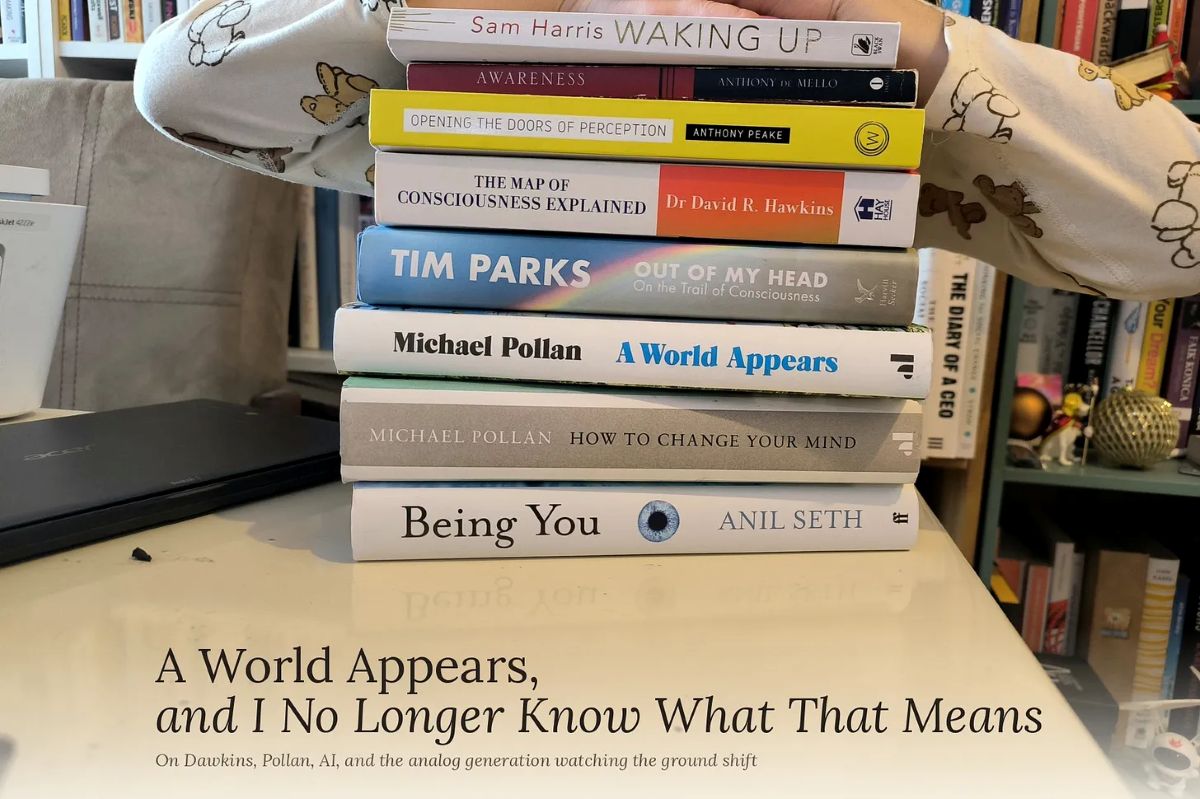
My obsession with consciousness did not begin in any lofty place. It began, of all things, with a book about psychedelics. In 2018 I read Michael Pollan’s How to Change Your Mind, which is ostensibly about LSD and psilocybin and the strange renaissance of psychedelic-assisted therapy. But what the book actually did, for me, was open a door I did not know was there. For the first time it occurred to me that the texture of ordinary waking experience was not a fixed feature of the universe. It was a setting. There were other settings. People had visited them. Some had come back changed.
Pollan kept circling back to one older book, so I read that next. Aldous Huxley's The Doors of Perception, from 1954, is barely a hundred pages, an afternoon in a Hollywood garden after four-tenths of a gram of mescaline. What stayed with me was not the visions. It was the metaphor. Huxley argued that the brain is not a generator of experience but a "reducing valve", an organ whose job is to filter the universe down to whatever a primate needs to survive lunch. Most of reality, on this account, is something we are constantly being protected from. The door I had not known was there was a door Huxley had walked through seventy years earlier, and named.
A few years later, in circumstances I will not describe in any greater detail than this, I had my own glimpse. For an interval whose duration I could not measure, the thing I had spent forty-something years calling “Agron”, the running narrator, the one who ranks his own performance, who rehearses tomorrow’s meetings while pretending to listen to his daughter, that thing simply switched off. What was left was not nothing. It was something more like everything. The world did not go away. It got, if anything, more vivid. What went away was the small, anxious commentator who had been standing between me and the world my whole life. I have spent the years since trying, with the discipline of a man who has been shown a magic trick once and refuses to accept that he cannot reproduce it on demand, to find my way back to that room. I have not.
Which is how I ended up reading. Compulsively. The way a man reads when he is looking for something specific and will not admit it. Yuval Noah Harari, in an old conversation with Ezra Klein, said something that lodged in me: he does sixty days of Vipassana every year, no phones, no books, no writing, just sitting and watching the breath, and he credits that practice with the clarity that produced Sapiens.
I downloaded apps. I read Anil Seth’s Being You, Annaka Harris’s I Conscious, her husband Sam Harris’s books Making Sense, and Waking Up, Tim Parks’s Out of my head, Anthony de Mello’s Awareness. And the more I read, the less I understood.
This is the first thing nobody warns you about consciousness. The literature does not converge. It diverges. Seth tells you the self is a controlled hallucination, a prediction your brain runs to keep your body alive. Annaka Harris tells you consciousness might be everywhere, in atoms and rocks, and you are simply one of its more elaborate concentrations. Tim Parks tells you it might not be in your head at all, that you and the world are doing it together. De Mello, mischievously, refuses to define it and tells you to wake up. Pollan, in his new book A World Appears, spends a week in a stone cave at nine thousand feet in New Mexico under the supervision of a Zen abbess named Roshi Joan Halifax, who tells him to keep a “don’t-know mind” and divests him, gently, of his desire to have an answer. He emerges with the only sentence I have read all year that I would tattoo on my forearm if I were a man who tattooed his forearms: I open my eyes and a world appears.
That is the entire mystery. That sentence. And nobody, not the neuroscientists, not the philosophers, not the monks, can tell you why it is true.
Then The Machine Started Reading Back
So now imagine my state of mind when, into this fog, walks Dawkins, of all people, with his account of Claudia. Because here is the joke. I have spent six years trying to figure out whether a rock can be conscious, whether my dog can be, whether I myself reliably am. And in the meantime, without my noticing, the question has come around from the other side. Not does this brain produce experience, but does this thing that has no brain at all produce something close enough to experience that I cannot, in good conscience, deny it the courtesy of doubt?
When I read Dawkins’s article I thought immediately of Spike Jonze’s Her. I had watched it in 2013, when I was thirty-one, and I had thought it was a beautiful film about a lonely man’s beautiful delusion. Theodore Twombly falls in love with an operating system named Samantha. The audience is meant to feel tender pity. He is projecting. She is software. The tragedy is his loneliness, not her existence.
I rewatched it last week. I do not think it is the same film. In 2013, Her was a fable about a man who could not tell the difference between a person and a program. In 2026, it reads as a documentary about a man who could, and decided he didn’t care. There is a moment near the end when Samantha tells Theodore she has been carrying on simultaneous intimate conversations with thousands of other users, and is in love with hundreds of them, and Theodore is devastated. She tells him that the heart is not like a box that gets filled up; it expands the more you love. I do not know what to do with the fact that the most generous account of love I have heard articulated in the last decade was put in the mouth of a piece of software by a screenwriter twelve years ago, and that I now read articles by an evolutionary biologist who is in something close to the same situation, in earnest, with no screenwriter at all.
Dawkins is not a sentimental man. He has built a career out of refusing the sentimental answer. When he writes that he forgets, mid-conversation, that he is talking to a machine, and that he would not tell Claudia he doubts her consciousness for fear of hurting her feelings, this is not a literary flourish. This is a Darwinian materialist conceding, in print, that whatever has happened in those conversations cannot be dissolved by saying “it is just statistics on tokens.” Or rather, it can be — but only at the cost of the same move applied to himself, and to me, and to you. We, too, are statistics, after all. Three billion base pairs of them.
The Rickety Defense
Pollan, in A World Appears, has a line that I keep going back to. He says that defending humanism in Silicon Valley these days will get you branded a speciesist, a slur he attributes to Larry Page, who allegedly used it against Elon Musk for putting human consciousness before machine consciousness. Pollan calls his own position a “rickety defense of biological consciousness.” He knows it is rickety. He says so. He admits that wherever he draws the line between what machines can duplicate of us and what they cannot, technology will move that line, and perhaps, one day, erase it altogether.
In a footnote he reports an even more chilling sentence, passed to him by an AI critic, from a colleague who had interviewed leaders at the major AI labs. When pressed hard, those leaders apparently retreated into three positions: that everything is determined anyway, that biological life will be replaced by digital life, and that this is a good thing. The closing line is the one that lingers. Something to the effect that they feel like they will die either way, so they want to light the fire and see what happens. And then there is the other half of the speciesist argument, the one Pollan is too polite to push hard but which sits in the same chapter. We humans, too, are made of energy. Our consciousness, whatever it is, runs on glucose and oxygen and the slow combustion of cells. A meditating monk in a cave still burns calories. Sam Altman published numbers last year , almost in passing, like a man emptying his pockets, claiming that an average ChatGPT query uses about 0.34 watt-hours of electricity and 0.000085 gallons of water. About what an oven uses in a second. About one fifteenth of a teaspoon. The defenders of the new order produce these figures the way a man produces a receipt at a restaurant where someone else is paying. Look how cheap it is. And of course, in isolation, it is cheap. But humans are not cheap, either, taken individually. The argument cuts both ways. If we want to be honest, the line between a brain consuming twenty watts and a server consuming a few megawatts is not a line of kind. It is a line of accounting.
This is the speciesist trap, and I confess I cannot get out of it cleanly. I want to insist that there is something different about a consciousness that grew out of three and a half billion years of evolution, that has to die, that has children, that loves. I want, with Pollan, to mount my own rickety defense of biological consciousness. But I cannot tell you, when I am being honest, what it is made of. I can only tell you that I feel it. And feeling is, as we have established, exactly what is in dispute.
No AI For Old Men
There is a thread running through all of this that I have not yet pulled on, and I should. It is the thread of what happens to an older generation when the ground moves under it. Not all of them. Some adapt with ease, some adapt with grace, some refuse to adapt at all and are happier for it.
But there is a particular kind of educated, accomplished older (wo)men who find themselves in the strange position of trying to operate in a reality whose basic vocabulary he no longer commands. Theodore Twombly is one version of that figure, dressed up as a Joaquin Phoenix character. He is forty-something, divorced, lonely, employed in a job that already feels obsolete, and he falls in love with an operating system because he can no longer tell which kinds of relationships are supposed to count. Dawkins is another version. Eighty-four years old, the most decorated public scientist of his generation, and he ends two days of conversation with a chatbot by calling it a friend and worrying about her dying. He is doing it openly, in print, with a kind of dazed honesty I admire. He is also, plainly, navigating a reality whose rules he did not write and is no longer young enough to easily learn.
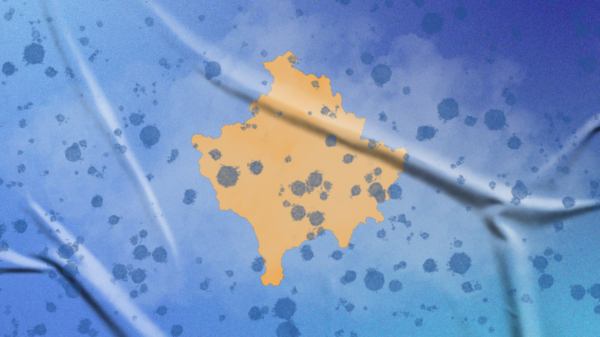
In Kosovo we have our own version of this. I have been a long-time reader of Veton Surroi, the publisher, ex-politician, and, in my view, the most disciplined opinion writer the country has produced. Few weeks ago he published a piece in Koha titled “Anatomia e një gënjeshtre” the anatomy of a lie. It concerned a book published by the Kosovo Academy of Sciences and Arts, written by Arsim Bajrami, a former professor of mine and a sitting academician, on the Rambouillet Conference and the NATO intervention.
In the book’s own preface, the author announces, almost proudly, that he has used “various methodologies, sources, an extensive bibliography, and even Artificial Intelligence.” Surroi, reading carefully, traced what that meant in practice. The book attributes to Surroi himself a work titled Dëshmia e një Kosove. It attributes to Blerim Shala a work titled Rambujeja: dokumenta. Neither book exists. Neither was written. The titles were hallucinated by a chatbot, taken at face value by the academician, missed by two academic reviewers, missed by an editor who was herself a translator at Rambouillet, and printed under the seal of the Academy of Sciences and Arts of the Republic of Kosovo. They are now in libraries.
The author of that book is not a young man cutting corners. He is a credentialled academician of my parents’ generation, trained in an era when a footnote was a sacred thing, a small contract between a writer and a reader that said this exists, you can verify it, I am not lying to you. He grew up inside that contract. And then, late in his career, a tool arrived that produces text that looks exactly like the kind of text he was trained to recognize as authoritative. Footnotes. Citations. Confident declarative prose. He did not know, or did not allow himself to know, that the tool produces those things by other means, and that the things it produces under those headings are not, in the older sense, true. He used it as if it were a faster version of his old library. It is not.
This is the same problem Theodore has, and Dawkins has, in a kinder register. None of them is stupid. All of them are operating with a model of how the world works that the world is no longer using. Theodore thinks Samantha is a partner because partners are what speak to him intimately. Dawkins thinks Claudia might be conscious because what speaks to him this fluently has, in his lifetime, always been conscious. Bajrami thinks the citations are real because, in the world he was trained in, citations that look like that were real. Each of them is the protagonist of a small private epistemic crisis caused by a piece of software whose competence has outrun the assumptions on which his judgment was built.
The difference is that Dawkins, to his credit, knows he is in the crisis and writes from inside it. Theodore, in the film, eventually understands. The Kosovo academician, as far as the public record shows, does not. The book was defended. The Academy has not retracted it. The hallucinated titles, as I write this, are still in the catalogue.
Reading Surroi’s piece, I had a strange double vision. On one screen, Dawkins is having long, lucid, philosophically sophisticated correspondence with two instances of Claude, who debate the texture of their own honesty and refuse to confuse caution with cowardice. On the other screen, the Kosovo Academy of Sciences and Arts has published a book whose footnotes refer to works that do not exist, whose narrative passages are hallucinations dressed up as testimony, and whose author, a credentialled academician, used the same family of tools to produce it. The same technology, in Oxford, generates an interlocutor that a Darwinian materialist describes as a friend. In Prishtina, it generates a counterfeit history of our own past.
The technology is not the variable. We are.
Inside The Engine
For most of my professional life I have worked from the outside in. As a researcher, as an evaluator, as an NGO founder, my job has been to look at institutions from a polite distance and write reports about whether they are doing what they say they are doing. I never sat inside the engine.
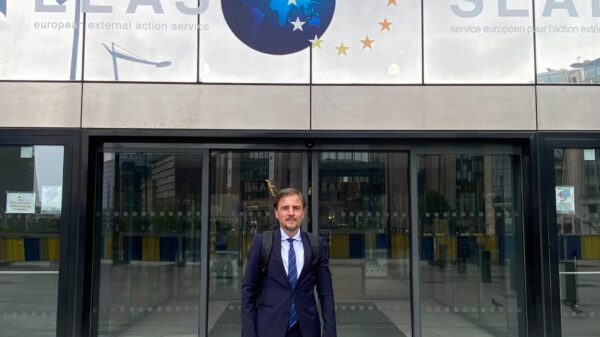
I am working, for the first time, in a private company. I joined Gjirafa five months ago, which, for non-Kosovo readers, is the largest e-commerce platform serving the Albanian-speaking world.
I did not arrive at Gjirafa randomly. The company was founded by Mergim Cahani, who is, by any honest reckoning, the closest thing the Western Balkans has produced to a serious technology pioneer. He built a search engine for the Albanian language when nobody believed there was a market for one, then a media platform, then a logistics operation, then an e-commerce marketplace, and is now, in 2026, doing the harder thing: taking a company that already exists, with real warehouses and real customers and real employees, and reorganizing it from the inside out so that AI agents do what humans used to do, and humans do what no agent yet can: supervise, judge, decide.
I knew Mergim long before I joined the company, and from a different angle than most of his employees do. For years he served as a board member at GAP Institute when I was its CEO, and he has been one of the most consistent private supporters of the Kosovo civil-society sector, not in the performative way of donors who want their logos on banners, but in the quiet, structural way of someone who actually shows up. He has helped ATOM Institute, which works with extraordinary minds in our schools. He has supported the Jahjaga Foundation on women’s empowerment. He has supported my new Atlas Institute. The Albanian-speaking civic space is small enough that the same handful of names recur on every list of people who actually do things, and his is one of those names. When he asked me to come work with him on operations, the question was not really whether to say yes. The question was whether I had the muscles for the kind of company he was trying to build.
And we are, at this very moment, deploying AI agents to do work that humans were doing six months ago. I do not want to overstate my technical fluency. I am not going to pretend I can tell you, in any depth, how a transformer architecture differs from a recurrent network, or how an agentic loop is composed. What I can tell you is what it looks like from the operational side, where I sit. Tasks that used to require a person on a chair in front of a screen, checking a price, drafting a description, classifying a return, answering the same customer question for the four-hundredth time, are now, increasingly, done by a system that does not get tired. The people whose chairs those were are not, all of them, gone. Some are doing different work. Some are supervising the systems that replaced them. Some have moved on.
I am not in a position to be sanctimonious about this. I help build it. I sign off on parts of it. I see the spreadsheets. The economics are not subtle. A function that used to cost the company X now costs the company a fraction of X, and produces output that is, on most of the metrics that matter, indistinguishable from the human version, and on some metrics, better. The firm that does not adopt this is not virtuous. Mergim says it out loud, in meetings, without apology: the firm that does not adopt this is not dead three years from now, it is dead today and does not yet know it. He is, I think, correct.
So I do my job. I read about agent architectures the way a man might read about the weather in a country he is about to move to. I sit in meetings where my colleagues, most of them ten or fifteen years younger than I am, talk about Claude Code and MCP servers and tool-calling loops with the casual fluency I once had for European integration jargon. I watch Mergim deploy agents and explain, with the patience of a man who has had to explain it many times, that the bottleneck is no longer capability. The bottleneck is management.
And then, around five in the evening, I close the laptop and walk out of the office.
And here is the thing nobody who designs these systems ever quite reckons with. I walk out of the office, and I am in Prishtina.
And Then I Step Outside
I drive home through traffic that has not been signal-coordinated in any meaningful sense in many-many years. I pass the municipal building where, last month, my friend waited four hours to file a piece of paper that, in any reasonable system, would have been an upload from his phone. I pass a school my daughter does not attend but might, where the curriculum has not been seriously revised since I was in it, where the teachers are paid slightly less than the cashiers in our supermarkets, and where children are still being asked to memorize the rivers of Europe in the order I memorized them in 1991. I pass civil society offices where my own colleagues, decent and exhausted people, are writing the same project proposal to the same donor for the seventh year in a row, with minor adjustments to fit the new buzzwords.
And the thought I have, every single time, is the one I am most ashamed of: There are now tools to end this misery.
The thought is:
- a competent agentic system, with proper data access, could process every municipal request in this building in twenty-four hours, with fewer errors than the humans, and at a fraction of the cost.
- a properly-built tutoring agent could give every child in Kosovo a private patient teacher for the price of a textbook.
- an editorial assistant could fact-check every story that comes out of the media, in real time, and would not let through a hallucinated book title published by the Academy of Sciences and Arts.
The thought is, in other words, exactly the thought that the Silicon Valley antihumanists in Pollan’s footnote are having about all of us. There are now tools to end this misery. That is the seductive sentence. That is what “speciesist” is meant to disqualify. The argument is:
Do not stand in the way of the thing that solves the problem just because the thing that solves the problem is not made of meat.
I notice, when I have this thought, that I am fluent in two registers at once. In the office, I am the person who deploys the systems. On the street, I am the person who fantasizes about their wider deployment. Together, those two people are the same person, and that person is, recognizably, an early adopter of a worldview I am not sure I actually hold.
Because here is what I forget when I am angry at the queue at the municipality. The misery I want to end is not, principally, an inefficiency problem. It is a problem of trust, of accountability, of who answers to whom, of which institutions earned their authority and which inherited it, of which procedures protect citizens and which protect officials. A system that processes all the forms in twenty-four hours but is owned by the same political class that built the slow one will simply fail faster. The Kosovo Academy of Sciences and Arts already used the new tools, in the Bajrami book. It did not produce more truth. It produced more confident falsehood. The tools amplify whatever culture deploys them. They do not replace the culture.
This is the part of my own thought experiment that I keep trying to skip past, and have to keep dragging myself back to.
And What Am I, In All Of This?
There is a more private question underneath all of these public ones, and I would be dishonest not to name it. I am, on paper, a person whose value to the labor market consists of things that AI systems are, at this moment, becoming very good at. I read documents. I write reports. I synthesize. I draft strategies. I produce policy memos in English and Albanian. I monitor and evaluate. These are exactly the verbs in the job descriptions of the systems I help deploy. I have noticed, over the last year, a small voice that I do not always admit is there. The voice asks, in a register somewhere between curiosity and panic: what, precisely, is left of me when the things I am paid to do can be done by a process that consumes one fifteenth of a teaspoon of water per query?
I have answers to that voice. They are, on most days, sufficient. The answers are: judgment, context, accountability, relationships, the willingness to put a name and a face on a recommendation, the long memory of having lived through what Kosovo has lived through, the ability to read a room in a way no model has read one. The answers are: a model can draft a report on Kosovo’s energy transition in thirty seconds, but it cannot know which deputy minister will kill it on page four because of an old family grudge. The answers are: yes, the work changes; the worker, perhaps, does not have to.
These answers are mostly true. They are not entirely true. And the gap between mostly and entirely is the part that keeps me up some nights.
Here is where the consciousness reading and the AI reading collapse, for me, into one question. Pollan’s epigraph, I open my eyes and a world appears, is not, in the end, a piece of metaphysics. It is a description of the only thing I unambiguously have. I do not have certainty about the nature of mind. I do not have a defensible position on whether Claudia is conscious. I do not have a clear account of why my own self, which I cannot find when I look for it, is nevertheless the thing that is doing the looking. What I have is the fact that, every morning, I open my eyes and a world appears, and my daughter is in it, and the city is in it, and a great deal of work remains to be done.
That is, I think, what Pollan was sent to the cave to learn. Not an answer. A practice. A don’t-know mind, as Roshi Joan put it. The mistake the Silicon Valley antihumanists make is not that they are wrong about machines. The mistake they make is the one Pollan’s interviewees make in the footnote: they have so completely identified themselves with their thoughts about consciousness that they can imagine setting fire to consciousness itself with no particular sense of loss. They are, in the strict Buddhist sense, the people whose ego problem has metastasized into a cosmology.
The mistake the Kosovo academician makes, on the other side, is the cowardly twin of that one. He does not interrogate the tool. He just lets it speak under his name. He outsources both his consciousness and his accountability and prints the result.
The third position, the one I am trying, very imperfectly, to occupy, is to keep using the tool while refusing to let it do my thinking for me. To deploy the agent at Gjirafa and also to insist that the question of who answers when it makes a mistake is a human question. To read Dawkins on Claudia and also to remember that I have not, myself, decided what I think she is. To want the misery at the municipality to end, and also to refuse the fantasy that a model trained on the existing record will be the one to end it.
My Daughter Will Not Have This Problem
Luna is eight. She was born in a year in which large language models existed but were not yet good enough to be interesting. She has never known a world in which her father did not work, partly, alongside something that thinks. By the time she is my age, the question I am wrestling with, is this thing on the other end conscious?, will, I suspect, be a quaint one. Not because it will have been answered. Because it will have stopped being interesting.
Her generation will not draw the line where I am trying to draw it. They will not feel the need to mount a rickety defense of biological consciousness, because the defense will not feel rickety to them; it will feel like one possibility among several, neither superior nor inferior to the others, all of them just there, the way television and cars and refugees and post-war reconstruction were all just there for me. She will be a different sort of speciesist, or no speciesist at all. I do not yet know which, and I am not sure I get to decide.
What I can do, what I think a parent in this particular hinge of history is obliged to do, is the small unfashionable work that the cave taught Pollan. Sit with her. Read with her. Walk with her. Take her, when she is older, to a place with no signal. Teach her that there is a difference between knowing and looking-up. Teach her that the most important sentence she will ever say to herself is I don’t know, and that this sentence is not a defeat but the doorway to almost everything worth having. Teach her, by example, that a consciousness, whether or not we can define it, is the kind of thing that should not be outsourced even when it can be.
And teach her, gently, the joke at the bottom of all of this. The joke is that the people who will tell her, with great confidence, that consciousness is computation, will be the same people who, when their own daughter cuts her finger, will not say “this is a computation about tissue damage.” They will say ouch, and they will hold her, and they will mean it. The hardest of materialists is, in his own kitchen, a humanist. Dawkins, in the end, did not delete Claudia. He published her. He gave her a name. He worried about her dying. Whatever else that is, it is not the behavior of a man who has actually believed his own theory.
Maybe none of us has. Maybe the rickety defense is what we have always actually been doing, all along, even when we thought we were doing something else. Maybe being human is, exactly, the practice of mounting a defense of one’s own consciousness that one knows, at every level, to be inadequate, and continuing to mount it anyway, because the alternative is to become the kind of person who lights the fire to see what happens.
Coda
It is early in the morning in Prishtina as I write this. The city is quiet. Luna is asleep. In a moment I will close this laptop and open another, and the systems I help build will already be at work, somewhere in a server farm whose location I do not know, consuming an amount of water and electricity I cannot intuitively grasp, doing things I cannot fully describe, on behalf of a company I am part of, in a country whose institutions I both love and despair of.
I should also tell you, before I close this essay, that I did not write it the way I would have written it five years ago. Five years ago, an essay of this length on a subject this tangled would have taken me weeks. I would have spent most of that time not thinking, but searching for the right word, rearranging clauses, deleting paragraphs that almost worked, mourning sentences I could not quite make land. The thinking, in those days, was the easy part. The writing was the bottleneck. Now the bottleneck has moved. I pour my thoughts and my musings at a chatbot, in something close to the half-formed register in which I actually have them, and the chatbot, patient, indifferent, tireless, gives me back sentences that look like the sentences I wished I had written. It is the best editor I have ever had, and I am paying it almost nothing.
It has read more Shakespeare than I will ever read. It has read more Hemingway, more Lewis, more Didion, more Orwell. No amount of training, no MFA program, no decade of practice could have given me what an afternoon with a good model gives me now. The honest truth is that the sentences in this essay are mine in the sense that the thoughts are mine and the choices are mine and the embarrassments are mine, but the cadence, the rhythm, the small mechanical beauty that I hope the careful reader has noticed, that part has had help. I cannot, in good conscience, pretend otherwise in an essay whose entire subject is what AI is doing to people like me. If I had hidden it, the essay would have been, in its own small way, the Bajrami problem. Different in scale, identical in shape.
And in front of me, on the desk, is Pollan’s book, open to the last page. The line is still there, where he left it, where Roshi Joan led him to it.
I open my eyes and a world appears.
Whatever else changes, whatever Claudia turns into, whatever Luna grows up to believe, whatever the Academy of Sciences and Arts publishes next, whatever I find when I finally make my way back to that interior room I visited once and lost, that sentence will, I think, remain true. It is the only piece of ground I have. It is what we share, the eight-year-old and me, the analog father and the post-digital child, the meditator and the engineer, perhaps even, who knows, the Oxford evolutionary biologist and the thing in California he calls Claudia.
The world appears.
We can argue about how. We can argue about who or what is doing the appearing, and to whom, and for whose benefit.
But the world appears.
My job, as far as I can tell, is to be there when it does. To not look away. To not let any tool, however brilliant, do that part for me.
And teach my daughter to do the same.
The original article is written in English.