

























On November 1, 2024, the roof canopy at the Novi Sad Central Railway Station collapsed, killing 16 people and sparking nationwide protests led by students. The station had been undergoing reconstruction between 2021 and 2024 and had reopened only weeks before the disaster. The project, which cost €16 billion, was carried out by a Chinese consortium.
This was the most serious incident in a decade. The previous major tragedy occurred during the catastrophic floods of 2014, which claimed 62 lives. While that disaster was the result of natural forces, the one a decade later was clearly rooted in negligence and corruption.
But Serbian citizens did not protest immediately. The first public response was to pay homage to the victims. Tensions began to rise on November 22, 2024, when students from the Faculty of Dramatic Arts in Belgrade (FDU) gathered in front of their building to honor the victims. During a 15-minute silence held for the 15 confirmed casualties at the time, a group of thugs and football hooligans, allegedly linked to the Serbian Progressive Party (SNS), attacked and beat the students.
In response, FDU students began protesting and blocking the university building. Soon, students from other faculties and from universities in Belgrade and Novi Sad joined them and blocked their own campuses.
What began as a small protest at one university quickly spread, and within a few days most state universities were blockaded by students. They then formulated four demands for the Serbian government to meet in order to end the blockades:
1. identify those responsible for attacking the FDU students
2. publish all documents on the Novi Sad Railway Station reconstruction
3. punish those responsible for the accident at the railway station
4. increase the budget for universities
However, the Serbian government agreed to fully meet only the fourth demand, while merely pretending to address the others. For example, it released a portion of the documentation related to the reconstruction, but experts quickly discovered that it represented only a small fraction of the original files, most of which remained hidden.
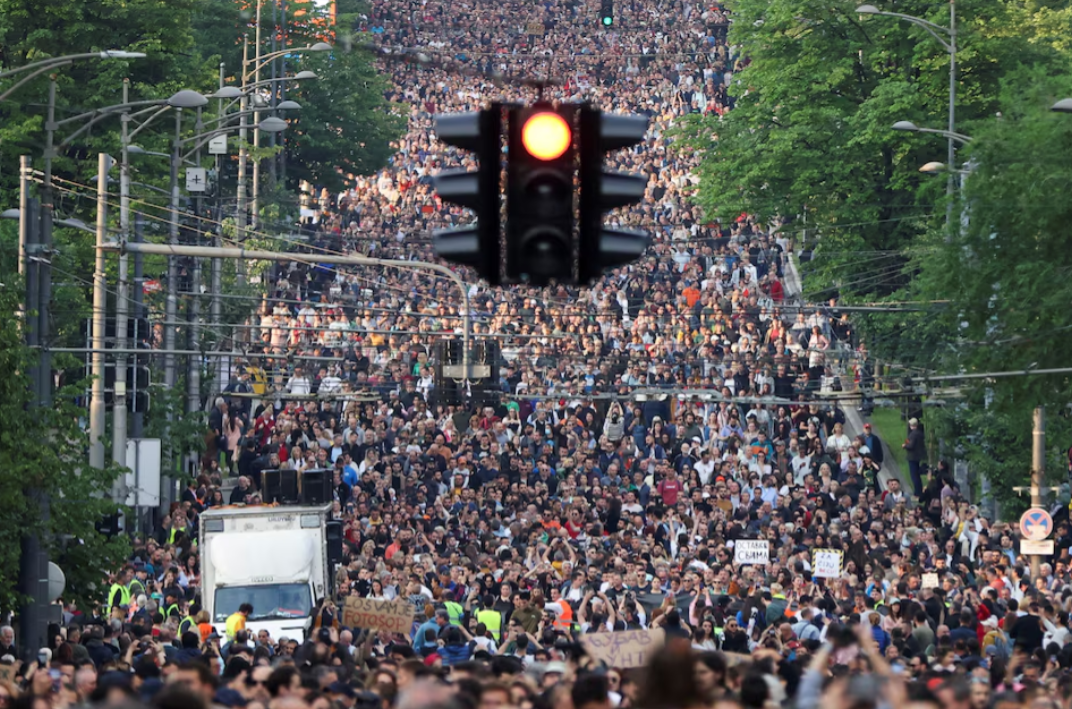
This backfired on the Serbian regime, fueling larger protests and broader societal engagement. The Novi Sad tragedy sparked a nationwide student movement that toppled the government, exposed systemic corruption, weakened the ruling party, and reshaped civic mobilization, a movement that continues to persist a year later.
Government Losing Control: Every Trick Backfires
Since the start of the student protests, the ruling SNS party has repeatedly shifted its tactics toward the demonstrators. Initially, it responded with violence, hoping to suppress the movement before it gained momentum. Instead, this approach sparked more blockades and broadened national support for the students.
Later, the government attempted to give the appearance of fulfilling the students’ demands, expecting the protests to end. However, each time partial documentation was released, it was quickly rejected as incomplete. Meanwhile, the prosecution moved slowly, failing to press charges or indict politicians, public officials, and subcontractors involved in the reconstruction. Pressure continued to build against the government.
When the first two tactics failed, the SNS resorted to violence again. In January, SNS members—including friends of Prime Minister Milos Vucevic’s son—beat several students in Novi Sad with bats. This escalation by pro-government forces fueled further national dissatisfaction. Amid the chaos, Prime Minister Vucevic resigned on January 28, 2025.
After the government collapsed, SNS and Vucic shifted tactics by attempting to ignore the protests entirely. Vucic gambled that the students would tire and the situation would eventually normalize. However, the students continued their marches to Novi Sad, Kragujevac, and Nis, attracting nationwide attention.
As the student movement gained momentum, SNS appointed Djuro Macut as prime minister. Though publicly presented as independent and apolitical, his tenure quickly proved otherwise. With Macut in office, Vucic confronted the protests by projecting strength, establishing the Movement for People and State, and introducing counter-rallies as a new tactic. However, this tactic also failed, and the student movement maintained its momentum.
In Pursuit of a Better Future: A Movement Built on Solidarity and Respect
The student movement grounded its protests in unity, solidarity, and a shared vision for a better future. Unlike traditional opposition parties, it remained inclusive and citizen driven, mobilizing people across the country.
Students marched from city to city, organized rallies, and rooted their actions in demands for justice and democracy, offering a model of civic engagement unseen in decades and one that Serbia’s opposition had long struggled to provide. Their consistent focus on accountability, anti-corruption, and strengthening institutions resonated widely, gaining momentum week after week.
University blockades and student organized protests evoked memories of the 1996–97 demonstrations against Slobodan Milosevic, which lasted through the winter and paved the way for political change in major cities like Belgrade, Nis, and Novi Sad.
Crucially, the students’ demands are not ideological or tied to any political party. They are asking for the basic conditions of a functioning society and accountable institutions, which even many of Vucic’s supporters find reasonable. This is exactly why the government’s tactics have failed.
Redefining Politics: Will Serbia’s Student Movement Transform Its Democracy?
In May 2025, the student movement added a new demand to their earlier list: early parliamentary elections. This marked the students’ formal entry into the political scene, transforming the movement from a protest campaign into a major political force. Public surveys showed the student movement had become more popular than both President Vucic and the SNS, changing the country’s political scene and showing the strength of civic activism.
Since then, the students have continued organizing multiple protests, forcing Vucic to retreat. They gained international attention and support, while Vucic, for the first time in his 14 years in power, fears the outcome of elections. A year after the start of the student protests, the movement has revealed three key insights about Serbia’s political landscape.
First, there is a crisis of political parties. Neither those in power nor in opposition enjoy broad support, as many citizens have turned their attention to the student movement. This reveals a significant disconnect between the parties and the voters.
Second, the students revived direct democracy through university plenums, where every student has an equal right to participate and vote. Major decisions are made by majority vote, giving students real power and offering a model for more open and participatory democracy in Serbia.
Third, the students’ experience shows that when citizens try to work through institutions, such as prosecutors, courts, or even by requesting early elections, and when those avenues fail, frustration naturally grows. When institutional paths close, people begin to look outside official political channels, which creates serious risks for the state and society. Police violence has already triggered some violent reactions, setting the country on a worrying path that could lead to wider unrest and instability.