



















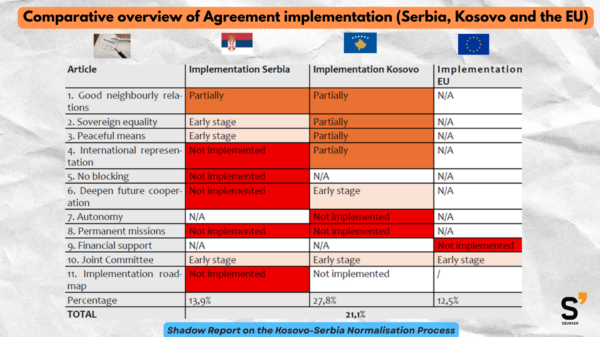
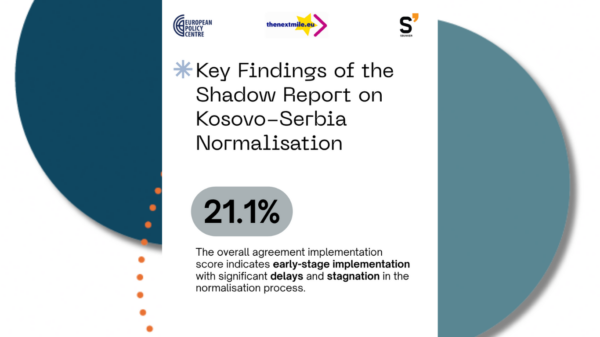
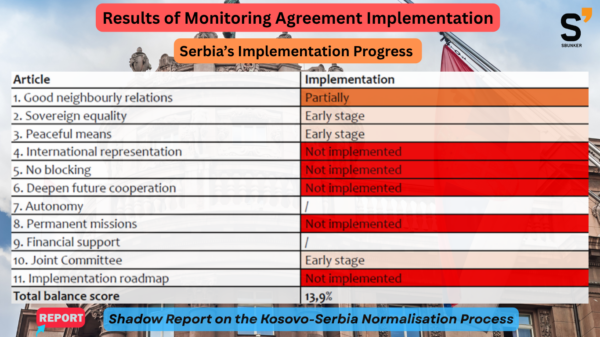
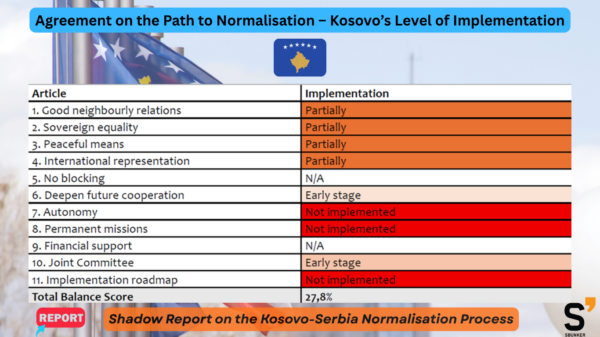
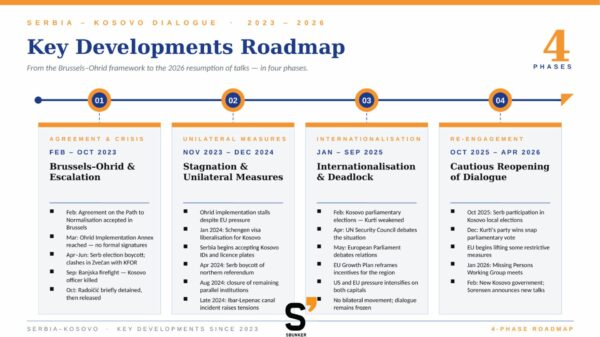


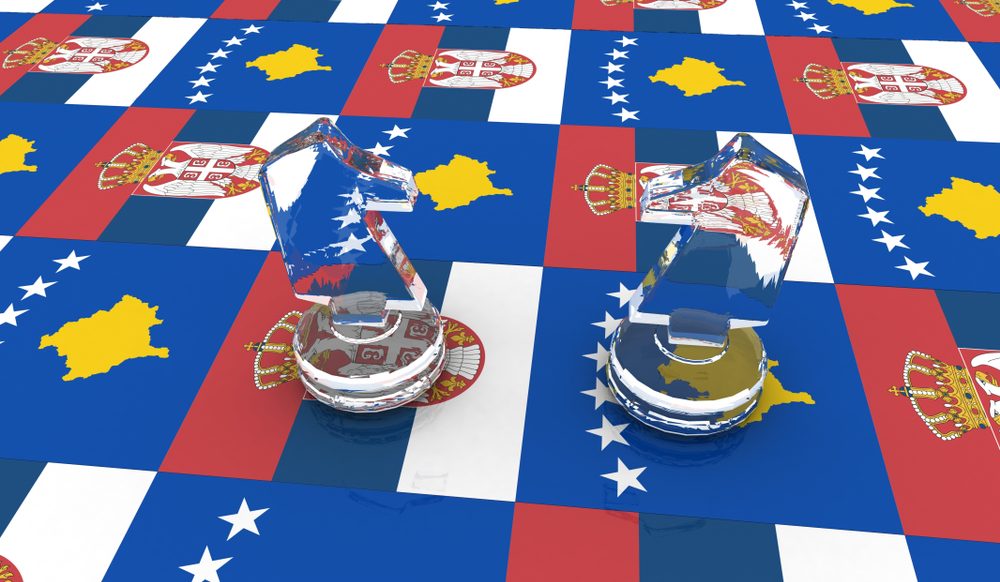
Except for the appointment of Peter Sorensen as the EU Special Representative (EUSR) for the EU-facilitated Kosovo-Serbia Dialogue, 2025 did not bring any major developments in the normalization process between Kosovo and Serbia. No high-level political meetings took place, marking two years since Kurti and Vucic last met.
Kosovo and Serbia shared a common experience throughout the year. Both went through intense internal political dynamics marked by a series of institutional crises, with domestic developments largely shaping and constraining their respective political agendas.
Although at first glance it seems that 2025 was lost with no progress in the Dialogue between Kosovo and Serbia, some notable processes took place during this year. This, together with the more proactive role of the EU, provides a good foundation for more positive and concrete results in 2026.
A Perpetual State of Stagnation
Kosovo spent most of the year in political deadlock after the parliamentary election held in February 2025 failed to produce a governing majority. As a result, Kosovo is now set to hold snap election on December 28, an unusually timed election date that falls in the midst of the winter holiday season.
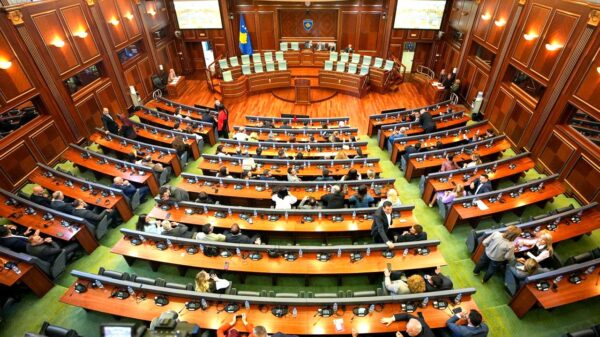
Kosovo’s Parliament repeatedly failed to elect a Speaker after the ruling Self-Determination Movement party nominated Albulena Haxhiu 54 times, with each attempt falling short of the required majority. The ruling party refused to compromise, despite holding only 42% of the seats, effectively blocking the formation of a new government and prolonging the institutional deadlock.
On the other hand, Serbia did not hold elections, despite sustained calls from student-led protest movements demanding them following the collapse of train canopy in Novi Sad. Throughout 2025, the country was largely paralyzed by a wave of popular protests that ignited levels of public unrest unseen in decades.
Although Prime Minister Vucevic resigned in January 2025, and a new government was formed without calling snap elections, the ruling authorities remained in a constant defensive posture as the student protests expanded rapidly and gained broader public support.
This effectively pushed the Kosovo issue out of Serbia’s public and political discourse, while the EU-facilitated dialogue lost priority for the Serbian government. At the same time, the absence of a functioning government in Kosovo made meaningful engagement in negotiations impossible, leaving the dialogue in a prolonged state of stagnation.
Behind the Scenes of Kosovo-Serbia Relations
Although the Kosovo-Serbia Dialogue was almost inexistent, several significant developments took place behind the scenes. While they may seem minor to a public preoccupied with domestic politics, these developments could prove pivotal for the continuation of the normalization process.
First, the appointment of Peter Sorensen as the EUSR for the Kosovo-Serbia Dialogue can be seen as an effort by the EU to keep the dialogue alive and maintain stability on the ground. Although no major developments happened in the Dialogue, this lack of progress cannot be attributed to him considering the political crises in both Kosovo and Serbia. Sorensen is a highly experienced diplomat with deep knowledge of the Western Balkans.
Second, after more than three years out of power following their 2022 resignation, Kosovo Serb representatives returned to Kosovo’s institutions. The Serb List won 9 of the 10 reserved Serb seats in the February parliamentary election and all 10 Serb-majority municipalities in the October local election, reaffirming its political dominance. The party also announced its participation in the snap election scheduled for December 28.
Third, progress was made in the work of the Joint Commission for Missing Persons. Although over 1,600 people remain missing and a declaration was signed in 2023, the Commission did not meet until 2025. Following a failed January meeting, it finally reconvened in December and formally began its work. This is an important step toward solving an important humanitarian issue and if it moves in the right direction will serve the ground for normalization.
Finally, the security situation in 2025 remained relatively stable. The year was calmer than previous ones despite some isolated incidents. This fragile stability was underscored by the latest U.S. Security Strategy, which highlighted how precarious peace between Kosovo and Serbia remains.
Is There Room for Optimism in 2026?
Given the chaotic events of 2024 and lack of progress in the Dialogue throughout 2025, a rational observer would be hesitant to expect significant improvement in 2026. Nevertheless, there is room for cautious optimism.
The return of Serbs to political life in Kosovo is a first sign of movement in a positive direction. Beyond political representation, the full reintegration of Serbs into the police and judiciary is likely to be high on the agenda of EUSR Sorensen, whose mandate is expected to be extended in February 2026.
Additionally, the EU’s decision to lift the sanctions imposed on Kosovo in 2023 is a positive step that could incentivize stronger engagement in the Dialogue. As the EU leverages geopolitical momentum to advance enlargement and is reinforced by Montenegro’s rapid progress in closing chapters, it has an opportunity in 2026 to steer normalization more decisively by placing Kosovo’s application on the Council’s agenda and requesting a Commission opinion. Such steps could motivate political elites in Pristina, encourage the full reintegration of Serbs, and advance the creation of the ASM.
In 2026, Kosovo is likely to form a new government following the December snap election, while early parliamentary elections remain a strong possibility in Serbia. If held, these elections could bring greater political and social stability to the country. With new governments and leadership in both Pristina and Belgrade, the environment may become more conducive to advancing the normalization dialogue.
In its December conclusions, the European Council called for a high-level meeting “once conditions are conducive.” The fact that various EU institutions are taking concrete steps regarding the Western Balkans helps set the stage for a potential breakthrough in normalization in 2026. The EU has allowed the process to stagnate for too long, and a change in approach appears likely in the coming year.