






































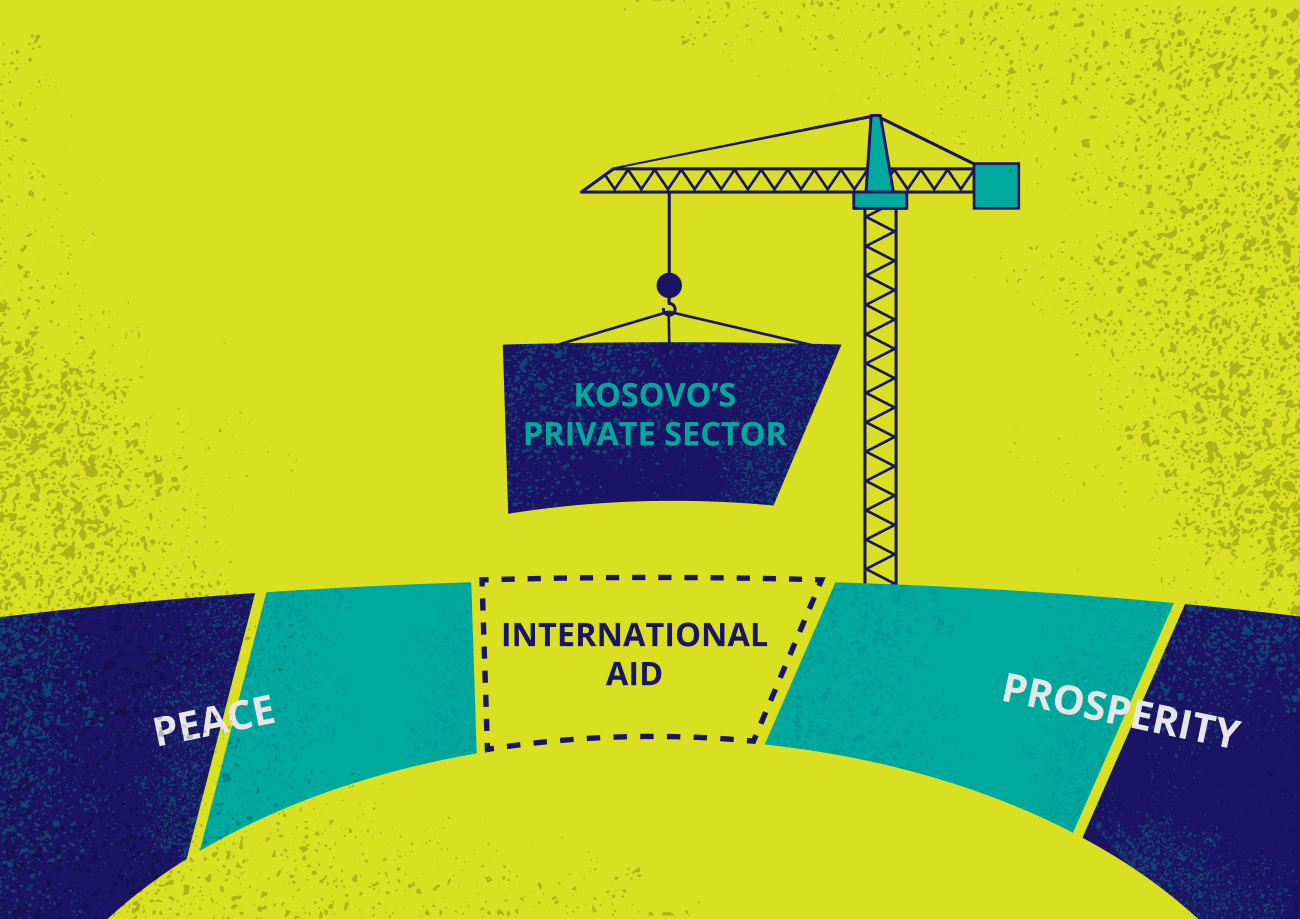
Since the end of the war in 1999, Kosovo has relied heavily on foreign aid to fund and implement democratization and peacebuilding initiatives aimed at strengthening institutions, fostering interethnic trust, and promoting human rights.
This international aid has played a crucial role in helping Kosovo transform from a post-conflict country into a functioning democracy. However, recent months have witnessed a sharp global reduction in such aid and assistance, creating major obstacles for developing countries such as Kosovo that still struggle with community reconciliation and cross-border cooperation.
This shift in international aid creates a critical void that threatens to undermine years of progress, but it also presents an unprecedented opportunity for Kosovo's private sector. With their vested interest in the country’s long-term success and deep understanding of local challenges, Kosovo’s businesses are uniquely positioned to become the driving force behind sustainable peacebuilding efforts.
Lack of International Recognition and the Ongoing Dispute with Serbia Continue to Impact Kosovo Economically
The economic costs of the ongoing dispute with Serbia are substantial. Without membership in intergovernmental organizations, such as the United Nations and the European Union, as well as full international recognition, Kosovo businesses operate at a significant disadvantage in the global marketplace.
This exclusion limits market access and imposes higher costs in international trade, equivalent to a 14% tariff. For Kosovo exporters, this means their products face an automatic price disadvantage compared to international competitors. Import costs also rise as suppliers factor in additional administrative complexity and perceived risk when dealing with an unrecognized state. These higher costs ultimately reduce profit margins for businesses and make consumer goods more expensive for ordinary Kosovars.
Meanwhile, Kosovo’s absence from the International Organization for Standardization (ISO) 3166 list—the globally recognized system that assigns unique codes to countries for international transactions, shipping, and digital services—prevents numerous companies and digital services from including Kosovo in their systems and forces local businesses to either register through third countries or operate without them.
This technical exclusion means Kosovo businesses cannot access many international e-commerce platforms, payment systems, or logistics networks that rely on ISO codes, effectively cutting them off from the digital economy and global supply chains.
As a result of limited investment and business opportunities, Kosovo faces unemployment rates of approximately 10.9%, well above the 4.92% global average. Additionally, Kosovo faces significant brain drain with annual emigration increasing from 15,000 to 20,000 a decade ago to over 35,000 Kosovars leaving the country every year, according to the Kosovo Office of Statistics. The emigration of highly trained professionals, particularly in healthcare and IT sectors, shrinks the specialized workforce and the number of high-income consumers, limiting both entrepreneurship and consumption in a vicious cycle. These economic constraints collectively limit Kosovo businesses’ growth potential and competitiveness.
The scaling back of funding from international donors now presents further risks to the private sector’s operational environment as many organizations in Kosovo focused on promoting peaceful dialogue and encouraging recognition face critical funding shortages.
Without sustained peacebuilding efforts, Kosovo faces increased potential for social tensions that could disrupt supply chains, reduce consumer confidence, and deter foreign investment. Moreover, the economic benefits of eventual normalization with Serbia remain unreachable without concerted efforts to maintain dialogue and build trust between communities.
Unlocking the Potential of Corporate Social Responsibility (CSR) in Kosovo’s Business Sector
Unlike international donors with shifting priorities and temporary mandates, local businesses have a lasting stake in Kosovo’s stability and prosperity. This positions the private sector to transition from indirect beneficiaries of peace to direct investors in peacebuilding.
While such engagement remains limited, examples are emerging. Heb's and Missini Sweets, for instance, have opened operations in North Mitrovica, creating economic bridges across divided communities, while The Rock – Smart Security helped fund a conference on civil-military relations.
Still, given that USAID alone provided about $73 million to Kosovo in 2023, filling the gap left by departing international donors will require substantial private sector mobilization.
Investing in Corporate Social Responsibility (CSR), a trend already growing throughout the Balkans, offers a structured avenue for businesses to align profit with purpose.
Corporate Social Responsibility (CSR) is a company’s commitment to running its business in a way that has a positive impact on society. Instead of focusing only on making profit, CSR-minded companies include social, ethical, and environmental issues in their daily work. This can include fair treatment of workers, supporting community initiatives, protecting the environment, and being transparent.
Many Kosovo businesses already demonstrate community commitment through both traditional practices—such as widespread participation in Zakat—and support of conventional community-focused activities like youth development, women’s empowerment, and environmental initiatives.
Companies like Meridian Express, FINCA, Raiffeisen Bank, dhe Rugove also already do some CSR-like branding of their community investments. However, Kosovo’s context calls for a CSR agenda that more directly tackles the unresolved dispute with Serbia and ongoing ethnic divisions.
There is also a strong business case for CSR. Companies that invest in socially responsible practices often see increased profits and better access to international markets, as consumers and partners favor companies that demonstrate community care.
In Kosovo, CSR efforts that support peacebuilding can both advance reconciliation and unlock valuable economic opportunities.
Practical Steps for Business Engagement
The transition from traditional business operations to active peacebuilding engagement doesn't require a complete overhaul of corporate strategy. Instead, Kosovo businesses can choose from a spectrum of engagement levels that align with their resources, capabilities, and risk tolerance.
Low-engagement approaches provide accessible entry points for businesses hesitant about political involvement. These include small donations to peacebuilding initiatives and organizations or public statements supporting the normalization of relations with Serbia. Such minimal commitments still signal corporate responsibility while requiring limited financial exposure.
Moderate-engagement approaches offer more substantial impact without requiring businesses to develop specialized expertise. These involve supporting peacebuilding organizations through donating services pro bono such as rental, supplies, and technical expertise. For example, Mercy Corps previously built inter-ethnic business connections in Kosovo by collaborating with business partners.
High-engagement approaches are the most ambitious, suited for larger companies or those with visionary leadership. They include leading or becoming involved in programs that promote dialogue and build social and economic ties across ethnic divides. For example, Turkish Cypriot and Greek Cypriot business chambers fostered cross-community business ties, boosting economic cooperation. Though resource-intensive, such efforts can position companies as leaders and offer long-term advantages by helping normalize Kosovo’s foreign relations.
As international aid recedes, the future of peacebuilding and the economic gains tied to normalization rests on domestic actors. Kosovo’s business community has both the means and the incentive to step up. Supporting peace is not just responsible; it is also smart business.