









For over ten months, Serbia has faced political turmoil, with student-led protests and university blockades exposing cracks in the regime. The government’s fall in January 2025 and the alleged use of a sonic weapon against protesters soon after severely undermined the legitimacy of President Vucic and Prime Minister Djuro Macut. For the first time since 2012, polls show most citizens believe Serbia is on the wrong track.
Despite the violence against protesters and political instability, international actors have continued to treat Belgrade as if nothing has changed. Vucic enjoys steady backing from his authoritarian allies in Moscow, Beijing, and Budapest, while Brussels, Berlin, Paris, and Washington have maintained a business-as-usual approach.
The situation escalated again in August, when violence erupted between police and protesters. By the end of the month, President Vucic wrote a letter to the President of the European Commission, Ursula von der Leyen, complaining about his own citizens and alleged organized violence from protesters.
However, the government’s violent crackdown on protests, marked by heavy police force, and media spin, is beginning to backfire. Following the August crackdown, Western sentiment began to turn against Vucic. Liberal groups within the EU openly expressed support for the protesters, and the European Green Party went so far as to send Members of the European Parliament (MEPs) to Serbia to monitor the situation firsthand.
These developments could soon mark a turning point in Brussels-Belgrade relations and, more broadly, in Western support for Vucic.
Vucic Unnerved as MEPs Visit Serbia to Observe Police Crackdown on Protesters
Two MEPs, Vula Tsetsi, co-president of the European Green Party, and her party colleague Rasmus Nordqvist, visited Serbia in person to first-hand scrutinize police action following allegations of brutality by students.
The surprise visit of MEPs caused tension in Belgrade. By then, the Greens, Liberals (Renew), and the Socialists and Democrats, almost all major groups in the European Parliament except the center-right European People's Party (EPP) and the far-right Patriots, had become openly critical of Vucic. This showed a clear shift in Brussels, where patience with his rule was wearing thin.
Vucic knew that high-level figures witnessing police brutality firsthand could bring serious trouble. And that is exactly what happened. The MEPs witnessed firsthand the repression of peaceful protesters in Novi Sad, alongside government-backed tabloid claims that the protests were violent and that police acted only in response.
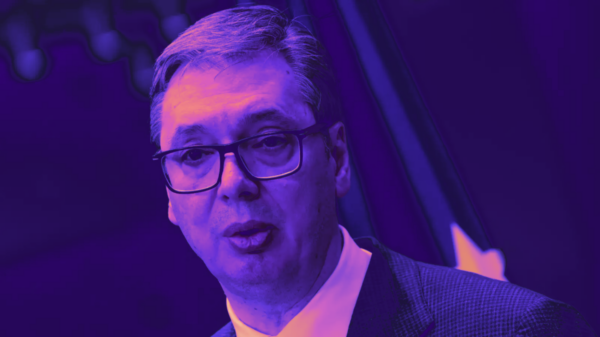
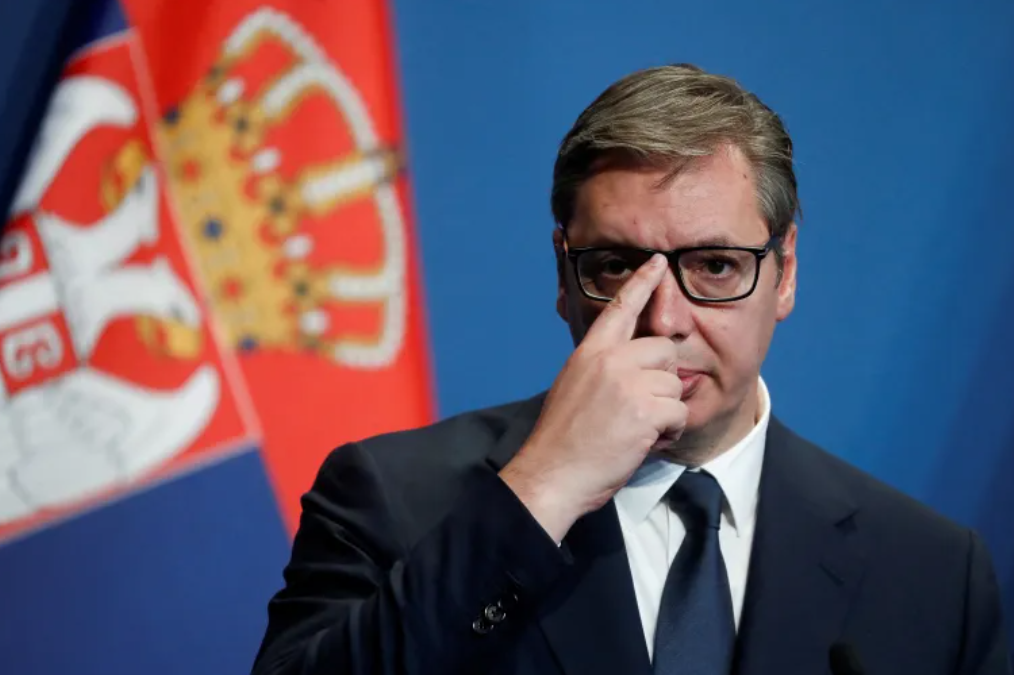
When the MEPs challenged this narrative, Vucic called an extraordinary media conference at 23:30, one that could be remembered as among the most significant in his 13-year rule.
The conference started 45 minutes late, shortly before midnight, and Vucic appeared visibly disturbed. During his speech, he lost his usual composure and began shouting. In his address, Vucic openly attacked the Brussels guests, calling them "scum" and threatening to arrest them, although MEPs enjoy immunity and such actions would be undiplomatic, scandalous, and in direct violation of international law.
Finally, students accused the police of using chemical weapons against them at the Novi Sad University campus the same evening. Chemical analysis of one of the tear gases dropped by police confirmed that CN gas, a toxic agent, classified as a chemical warfare agent, was used on 5 September in Novi Sad. German Bild already picked up this information and wrote about it, further complicating Vucic’s position.
The visit of MEPs in Belgrade produces a domino effect in Europe
Marta Kos, the EU Commissioner for Enlargement, commented on the Western Balkan countries’ progress toward EU membership during her visit to Vienna on September 8. Speaking about Serbia, she stated in German:“Wir haben ein Problem in Belgrad” (“We have a problem in Belgrade”).
This was the first time a high-ranking EU official unequivocally criticized Vucic. Kos emphasized that freedom of assembly and peaceful protest are fundamental human rights, deeply rooted in EU treaties and principles. This marks a critical point in EU-Serbia relations and signals diplomatic distancing from the Vucic regime.
Additionally, Manfred Weber, chairman of the EPP, announced that the group will reconsider SNS’s membership. The EPP has long served as a political lifeline for Vucic in Brussels, easing critical EP reports and defending SNS against pressure from other parties and institutions. Without this backing, Vucic would be far more exposed both in the EU and internationally.
The European Policy Centre (EPC), a prominent think tank based in Brussels, cancelled the event at which the Speaker of the Serbian National Assembly, Ana Brnabic, was scheduled to attend. Eventually, Brnabic travelled to Brussels just to organize the event at the Serbian embassy and meet with EP President Roberta Metsola.
Even this meeting with Metsola looked awkward, as it was probably arranged hastily. Nonetheless, Brnabic used the meeting to point out in the media statement afterwards that there were no issues between SNS and EPP, denying the possibility of SNS’s expulsion.
Despite the tide turning against Vucic, it is too early to say whether this marks the end of his regime. However, over ten months of protests have shown that citizen resilience can yield results, and they have now cracked the last pillar of his power: international support.
Vucic’s only remaining lifeline in the West appears to be the U.S. After backing Trump last November, he recently met with the US Secretary of State, Marco Rubio, who announced the launch of a U.S.-Serbia special dialogue during their meeting in New York.