












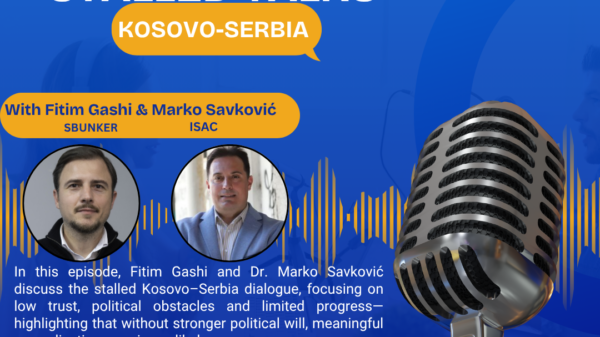








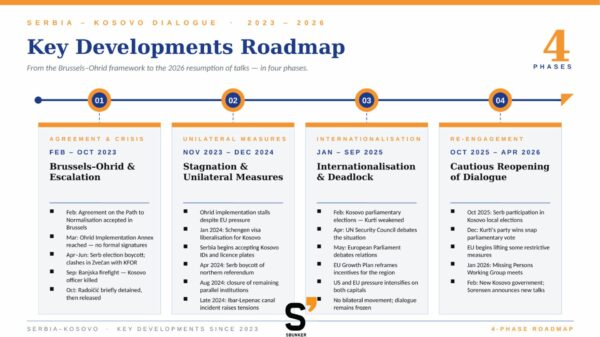

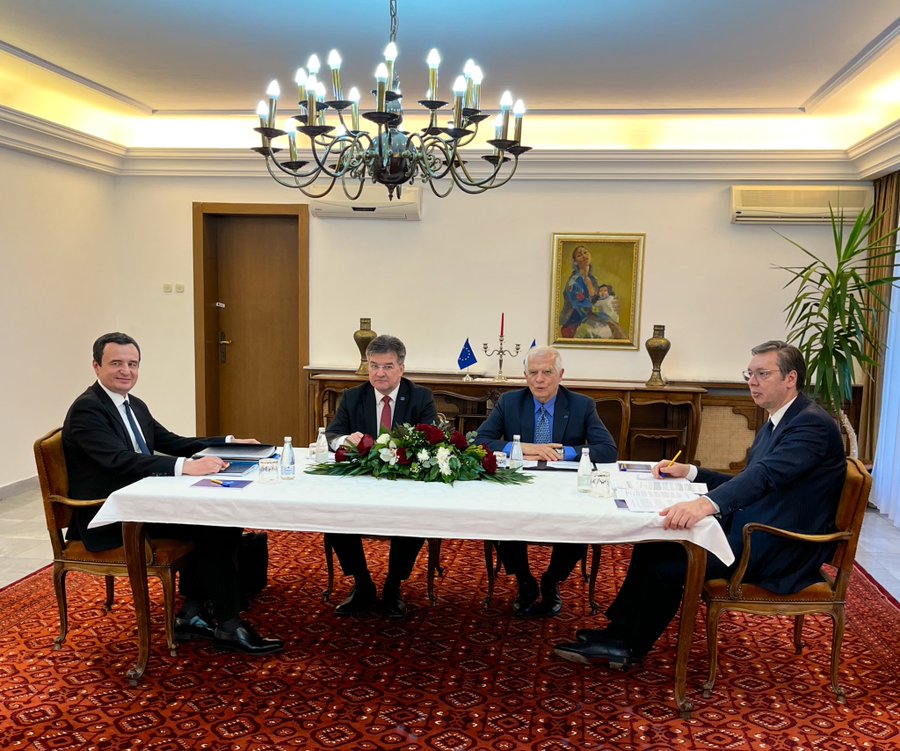
On March 18, 2023, then-EU foreign policy chief Josep Borrell tweeted enthusiastically, “We have a deal,” announcing that Kosovo and Serbia had reached the Agreement on the Path to Normalization, later known as the Ohrid Agreement.
The 2013 Brussels Agreement was long seen as the central framework for normalization, but the Ohrid Agreement has now taken over as the primary reference point in relations between Kosovo and Serbia.
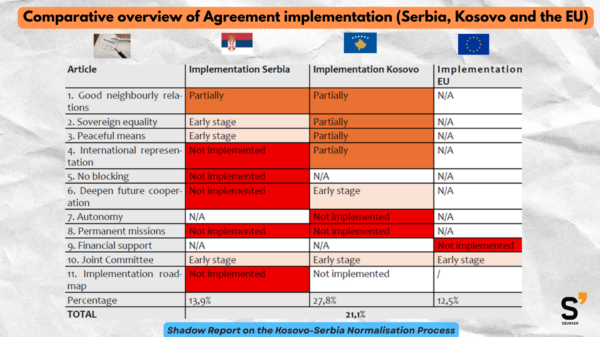
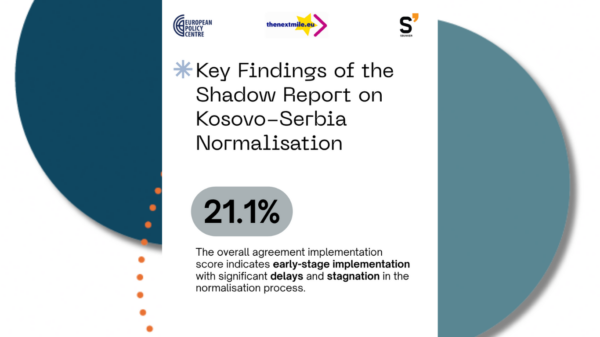
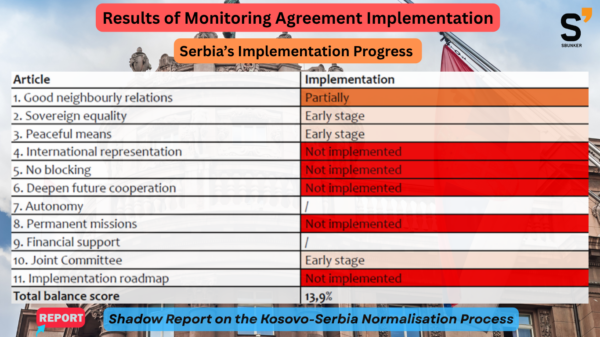
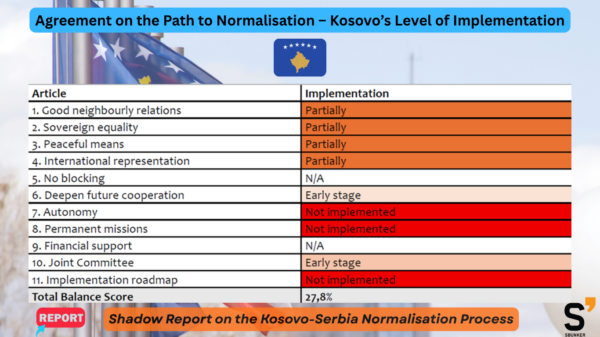
The Ohrid Agreement contains eleven articles, yet three years on, its implementation has been minimal at best, with none of the articles fully implemented. Of the 11 articles, only three have been partially implemented by both sides, two more by Kosovo alone, while the remaining ones remain largely unimplemented.
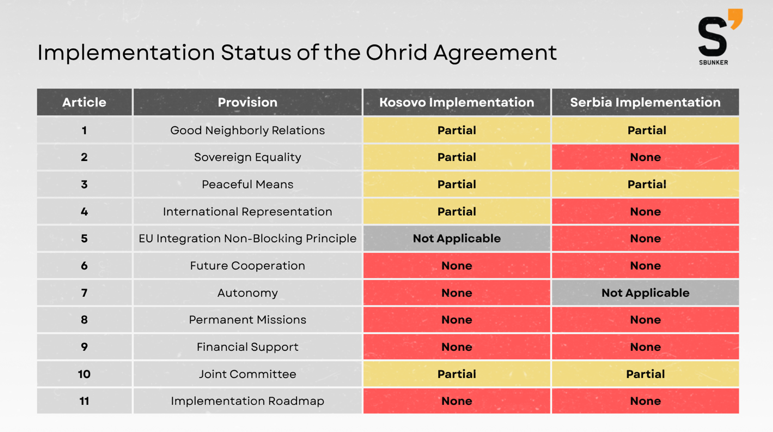
- Good Neighborly Relations
Kosovo-Serbia relations over the past three years have been far from good neighborly. Kosovo accused Serbia of trying to annex northern municipalities amid ongoing tensions, all the while after meeting in Brussels in September 2023, there have been no high-level political meetings between the two sides. Although Serbia did recognize Kosovo IDs and license plates in December 2023, overall relations between Belgrade and Pristina remain constrained.
- Sovereign Equality
Serbia still rejects Kosovo’s sovereign equality and continues to claim its entire territory. Although it has verbally endorsed the agreement, Serbian President Aleksandar Vucic expressed afterwards. As a result, Serbia still does not treat Kosovo as a sovereign and equal state. Moreover, in December 2023 during the EU-WB Summit, Ana Brnabic, Prime Minister at the time, sent a letter to the EU putting reservations on Kosovo’s sovereignty, its membership in the UN and de facto dhe de jure. and de jure recognition. Although EUSR Lajcak later stated that the latter has been withdrawn, it seems like the position of Serbia has not been changed.
- Peaceful Means
Peaceful dispute resolution in the context of Article 3 remains contested in light of the Banjska and Ibar-Lepenac terrorist attacks, rising military spending, and saber-rattling. Moreover, the presence of special police units in the north of Kosovo with multiple fortified police bases under construction in this region sends the wrong message. In the meantime, Serbia is conducting military exercised near the border with soldiers practicing airborne assault. Undoubtedly, there is a peace between Kosovo and Serbia, but it is rather a fragile one.
- International Representation
Serbia has continued to oppose and block Kosovo’s membership in international organizations, most notably the Council of Europe, in violation of Articles 4 and 5 of the Agreement. It has also maintained a key rezreservation against Kosovo’s membership in the United Nations.
- EU Integration Non-Blocking Principle
According to the Ohrid Agreement, Serbia should neither block nor encourage others to block Kosovo’s progress on its EU path, and vice versa. However, while Serbia cannot formally block Kosovo’s accession, it has been content to see non-recognizing EU member states keep Kosovo’s candidacy stalled since its application for membership in 2022.
- Future Cooperation
Bilateral relations are at their lowest point since the normalization dialogue began, with no progress on deepening cooperation under Article 6. The Agreement envisions expanded cooperation across areas such as the economy, science and technology, transport, justice, telecommunications, health, culture, and environmental protection, among others, through specific agreements. However, the only tangible development so far has been a single meeting of the commission on missing persons.
- Autonomy
This article explicitly establishes the obligation to provide an “appropriate level of self-management for the Serb community in Kosovo, building on the Brussels Agreement and drawing on relevant European models of minority governance. In practice, this commitment is closely tied to the establishment of the Association of Serb-Majority Municipalities, which remains unrealized. Progress has stalled due to continued political resistance within the Kosovo Government.
- Permanent Missions
There has been no progress toward establishing permanent missions as envisaged under Article 8. Diplomatic communication continues to be conducted through liaison officers. Notably, in 2023 and 2025, the Serbian government, for the first time, refused to allow a Kosovo liaison officer to visit a Kosovo national arrested in Serbia.
- Financial Support
Given the overall lack of progress in implementing the Agreement, the EU postponed the creation of a special investment and financial support package (Article 9). This sends a strong message to both sides: avoiding obligations and allowing the process to stagnate carries consequences. Similarly, the Growth Plan, a separate financial instrument, includes progress in the dialogue as a key precondition for disbursement.
- Joint Committee
The Joint Monitoring Committee (JMC) was established in 2023, 30 days following the Ohrid Meeting as envisaged by Article 10. All three sides have (EU, Serbia and Kosovo) delegated their representatives, while JMC is presided by the EUSR. Although the JMC was established, it remains unclear how often the JMC was meeting and what the results of its work were. There is no data available.
- Implementation Roadmap (Implementation Annex)
Article 11 establishes that the Implementation Roadmap, or the Implementation Annex, is mandatory for both parties. The Annex clarifies existing articles and sets additional obligations. Its implementation is somewhat more positive than other parts of the Agreement, though several points remain unfulfilled.
The most important obligation, dating back to 2013, is for Kosovo to start negotiations on arrangements to ensure self-management for the Serb community. No previous agreements in the EU-facilitated dialogue have seen such poor follow-through. This raises a crucial question: is the problem with the Ohrid Agreement itself, the EU’s facilitation, or simply a lack of political will in Belgrade and Pristina?