


































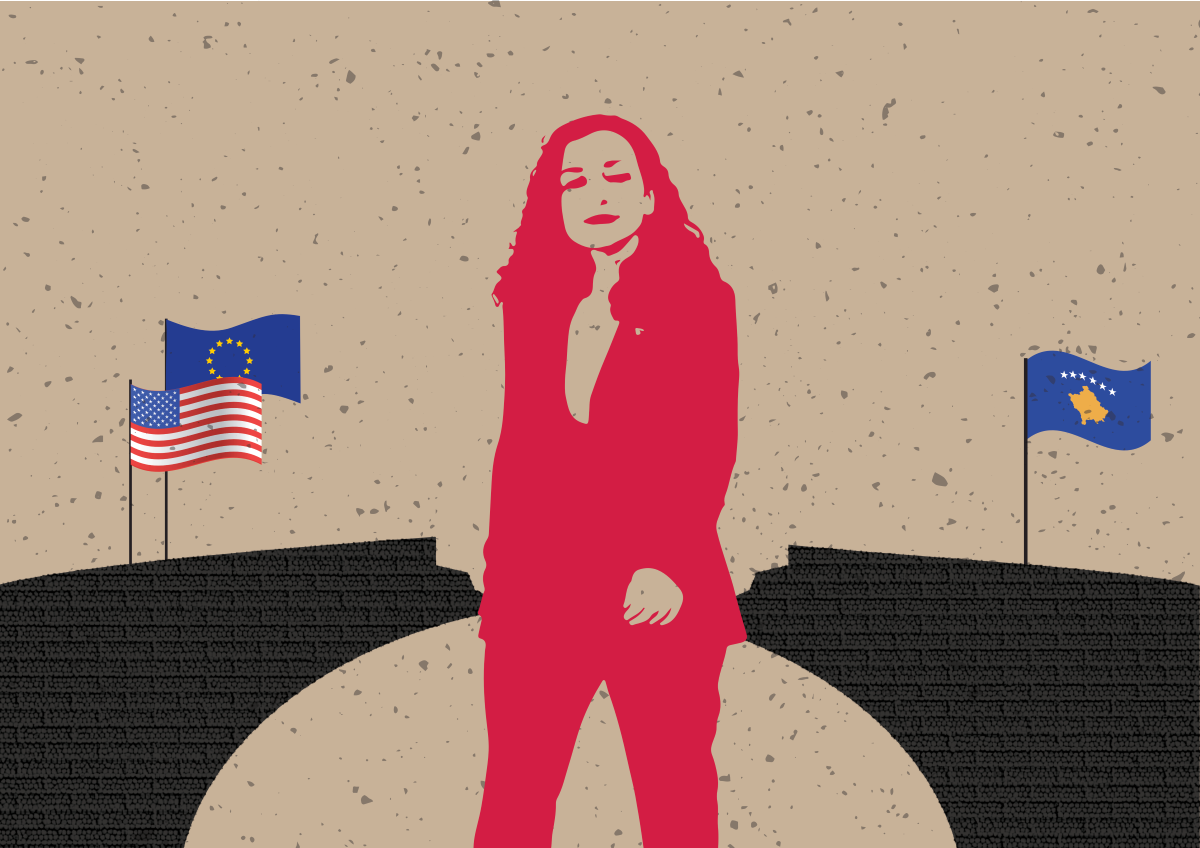
Vjosa Osmani assumed the office of the Presidency on April 4, 2021, becoming the second woman to hold the position in Kosovo’s young history. Her presidency has been marked by both achievements and setbacks, leaving a contested record that continues to shape Kosovo’s political discourse. As her five-year mandate nears its end, her tenure invites reflection and critical assessment.
Cleaning House: Politically Motivated Decisions
One of President Osmani’s first decisions after assuming office was the dismissal of the head of the Central Election Commission (CEC), Valdete Daka, on the grounds that she had violated the independence and integrity of the CEC. Daka had become a primary target for the newly elected Self-Determination Movement (LVV) after the CEC had previously refused to certify its leader Albin Kurti and several other party members to run in the 2021 election due to legal issues.
President Osmani, who ran as the LVV’s lead candidate in 2021, dismissed Daka in a move widely seen as politically motivated. The accusations against Daka were considered baseless, as under her leadership Kosovo’s elections had been praised for professionalism, with preliminary results delivered within hours. The consequences of Osmani’s decision became evident in the February 9, 2025, general election, which faced numerous problems and delayed the CEC’s finalization of the results by over a month.
The Kurti government also urged President Osmani to dismiss 12 politically appointed ambassadors, citing the need to increase the share of career diplomats, as required by the Law on Foreign Service. However, several career diplomats were also dismissed, suggesting the move largely served to consolidate control and install loyalists. The mass dismissals and lack of a smooth transition left Kosovo without senior diplomatic representation in 23 missions for over six months, hampering diplomatic efforts and undermining Kosovo’s reputation abroad. Today, most key embassies are still led by political appointees, including those in Brussels, Lisbon, London, Rome, and The Hague.
While the Kurti-Osmani duo has been unforgiving to diplomatic staff abroad, a troubling double standard emerged with Ambassador to Croatia Martin Berishaj, a close confidant of Kurti, accused of concealing €1.5 million, tax evasion, and money laundering. Osmani initially sided with Kurti in shielding him, but as relations between Kurti and Osmani began to deteriorate, Osmani later urged Berishaj’s resignation. The following year, Osmani visited Croatia in an official capacity, and while it is customary for the ambassador to accompany her, she refused Berishaj’s presence. Despite the serious allegations, Berishaj remains in his post, underscoring political favoritism.
Bandwagoning with the Kurti Government’s stance on the Kosovo Serb Community
The Kurti government has acted unilaterally in restricting social services for Kosovo Serbs, without consulting the community or key allies, and has failed to advance the draft statute on the Association of Serb-Majority Municipalities (ASM). Despite agreeing to the 2023 Ohrid Agreement, pledging self-management for Serb-majority municipalities, the government has made no progress on these commitments.
Rather than mitigating the government’s actions, Osmani has reinforced pressure on Kosovo’s Serb community. In 2022, she echoed Prime Minister Kurti’s stance that Kosovo was not required to establish a “new Republika Srpska.” Just a year later, she reversed course, declaring the ASM both unavoidable and a legal obligation, even expressing willingness to co-draft a new statute in line with the Constitution and with U.S. support. These contradictory statements suggest that Osmani’s positions are driven less by conviction than by shifting political circumstances.
In July 2025, President Osmani withdrew her request to the Constitutional Court regarding the constitutive session of the parliament after learning that Serb judge Radomir Llaban had been appointed as the rapporteur, citing him as a national security threat, specifically referencing his activities from 2021 onward. While Osmani’s concerns may be valid, the claim was made without any public evidence and raised the question of why no action had been taken earlier if Llaban indeed posed a national security threat. By framing a sitting Kosovo Serb judge as a security threat, she undermined the credibility of the judiciary, the Constitutional Court, and non-majority community rights.
More recently, the newly elected head of parliament, Dimal Basha of LVV, declared the parliament constituted, despite the Rules of Procedure requiring five deputy presidents, including one from the Serb community. In this case, only four deputy presidents were selected, none of whom were from the Serb community. Despite this clear violation, President Osmani backed the government’s approach. The Constitutional Court later confirmed that the parliament was not properly constituted due to the missing deputy president from the Serb community.
The President’s role is crucial under the Kosovo Constitution, which states that the President “represents the unity of the people.” Given that Kosovo is defined as a multi-ethnic state, this includes all non-majority communities. Yet, Osmani has repeatedly failed to fulfill this duty, particularly during moments when national cohesion and the inclusion of non-majority communities were most needed.
A Foreign Policy in Disarray
Kosovo’s foreign policy has suffered from a lack of coordination and coherent strategy. This disunity is most evident in the disconnect between the Presidency, the Prime Minister’s Office, and the Foreign Ministry. It was particularly visible when Kosovo failed to secure membership in the Council of Europe and again during the September 2025 visit to the U.S., where the President, Prime Minister, and Foreign Minister traveled separately, each pursuing their own agenda.
In addition to a lack of a unified strategy, relations with key allies have deteriorated to a concerning degree. EU sanctions remain in place, and ties with the U.S. have reached a nadir. In an attempt to mend relations, President Osmani has visited the U.S. 20 times since taking office. Although she has visited the U.S. very frequently, she has struggled to secure bilateral meetings with senior White House representatives.
Osmani’s only U.S. bilateral visit was in July 2022, when she met with Secretary of State Antony Blinken. During the same visit, Kosovo signed a $200 million grant agreement with the Millennium Challenge Corporation (MCC) to support the country’s energy sector. Since then, Kosovo has yet to meet senior White House officials.

Such frequent trips might be justified if they produced tangible results, but they increasingly appear aimed at boosting media visibility and projecting a presidential image abroad rather than strengthening Kosovo’s diplomatic standing. Furthermore, Osmani often travels with a large entourage, including a personal photographer and videographer, ensuring every meeting and appearance is showcased.
When she does meet with U.S. officials, these meetings seem more like symbolic engagements than substantive visits. For instance, on July 9, 2025, President Osmani met with Brendan Hanrahan, Senior Bureau Official for the Bureau of European and Eurasian Affairs. That same day, Hanrahan announced plans to visit Bosnia and Herzegovina, Serbia, and Kosovo, making Osmani’s meeting appear out of sync with U.S. plans.
Over the past few years, Kosovo-U.S. relations have witnessed a series of crises. The most serious setback came on September 12, 2025, when the U.S. Embassy in Kosovo suspended the Strategic Dialogue, citing the “caretaker government actions that increased tensions and instability.” The U.S. Strategic Dialogue is a high-level initiative to promote mutual interests in areas such as defense, energy, and trade with the goal of advancing Kosovo’s Euro-Atlantic integration and reinforcing a deeper strategic partnership with the U.S.
For a partially recognized country such as Kosovo, the stakes are particularly high. However, instead of taking substantive action to address the situation, Osmani issued a statement voicing concern and regret.
Notable Milestones in Foreign Policy
Despite setbacks in Kosovo’s foreign policy, President Osmani has achieved notable successes on the international stage, representing Kosovo with professionalism and eloquence in summits, conferences, and official meetings. Her combination of political experience, education, and fluency in English has enabled her to communicate effectively with global leaders, enhancing Kosovo’s visibility and credibility abroad and projecting an image of capable leadership.
Arguably her most significant diplomatic achievements came in April and October 2025, when South Sudan and, later, Syria recognized Kosovo’s independence. These milestones marked progress in recognition efforts that had stalled under the Kurti government, which failed to secure any new recognitions during its four-year term.
President Osmani also demonstrated responsiveness and international goodwill in 2021 by offering shelter to Afghan refugees at President Biden’s request, a meaningful gesture given Kosovo’s limited capacity.
Additionally, her diplomatic tour in Latin America, including the opening of Kosovo’s embassy in Colombia, likewise reflected a proactive approach to sustaining and strengthening bilateral relations in a region that Kosovo rarely engages with.
Quiet When It Matters: Lack of Leadership on Important Issues
Under Prime Minister Kurti, Kosovo has experienced significant democratic backsliding, with independent media and civil society facing mounting pressure. Attacks on the judiciary, particularly the Constitutional Court and State Prosecutor, are increasingly frequent. Beyond domestic challenges, Kosovo is more isolated than ever, relations with key allies are declining, and EU sanctions remain in place.
As Albin Kurti’s and LVV’s rhetoric and attacks against independent institutions has escalated, President Osmani has largely remained silent. In Kosovo, those who critique the government and its actions often face backlash, with dissenting voices frequently portrayed as adversaries of the government or serving the interests of Serbia.
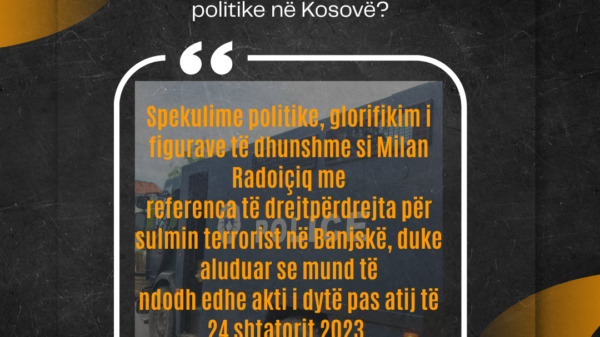
Rather than defending press freedom, President Osmani has accused certain Kosovo journalists of links to Milan Radoicic, the criminal behind the 2023 Banjska attack. This pattern of criticism towards the media has also been evident in past statements by her husband, Prindon Sadriu, who labeled journalists a “joint criminal enterprise.”
Hostile language toward the press has coincided with a steep decline in press freedom. Kosovo fell 43 places in the World Press Freedom Index between 2022 and 2024, reflecting both a deteriorating media environment and broader democratic erosion.
Overall, Osmani secured some diplomatic successes and gained international visibility, but her tenure was undermined by her failure to hold the Kurti government accountable and assert the authority of the presidency when needed. Her inability to serve as a unifying figure and defend democratic principles has weakened the presidency itself.
As President Osmani’s term comes to an end, the central question is whether Kosovo’s presidency can reclaim its role as a guardian of national unity and democracy, or whether it will continue to be shaped by partisan interests. For a young democracy facing internal fragmentation and democratic backsliding, the stakes could not be higher.