














































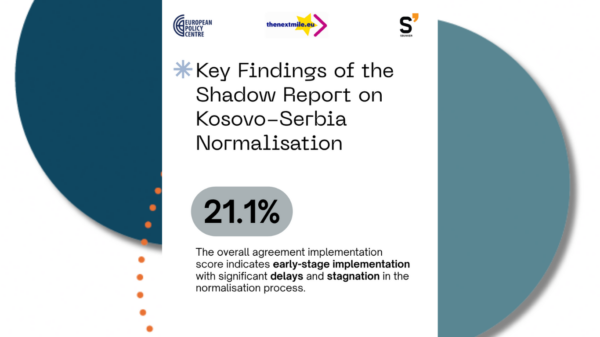
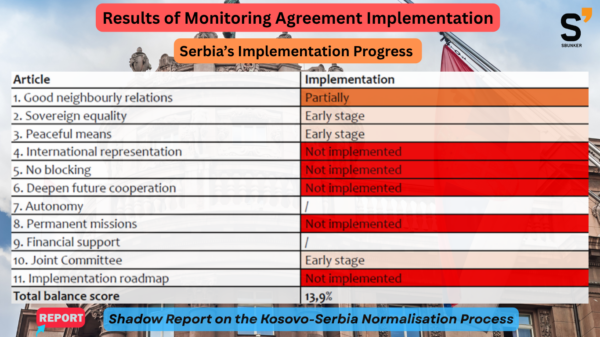
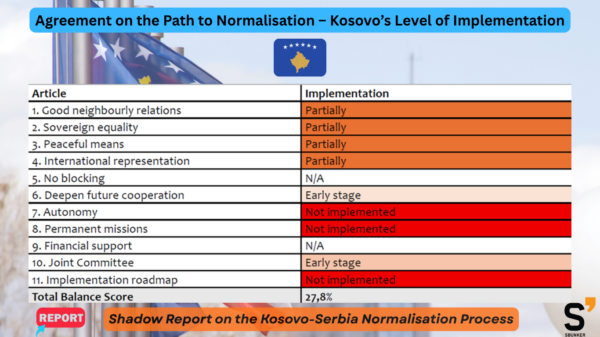
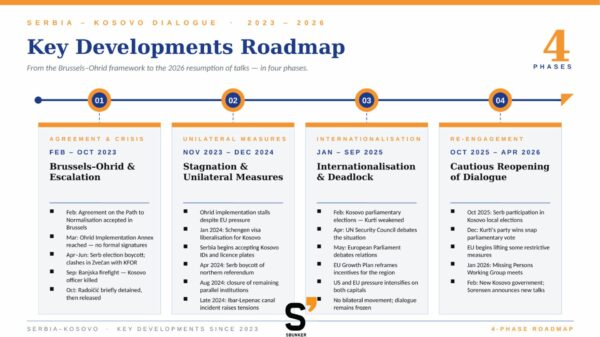





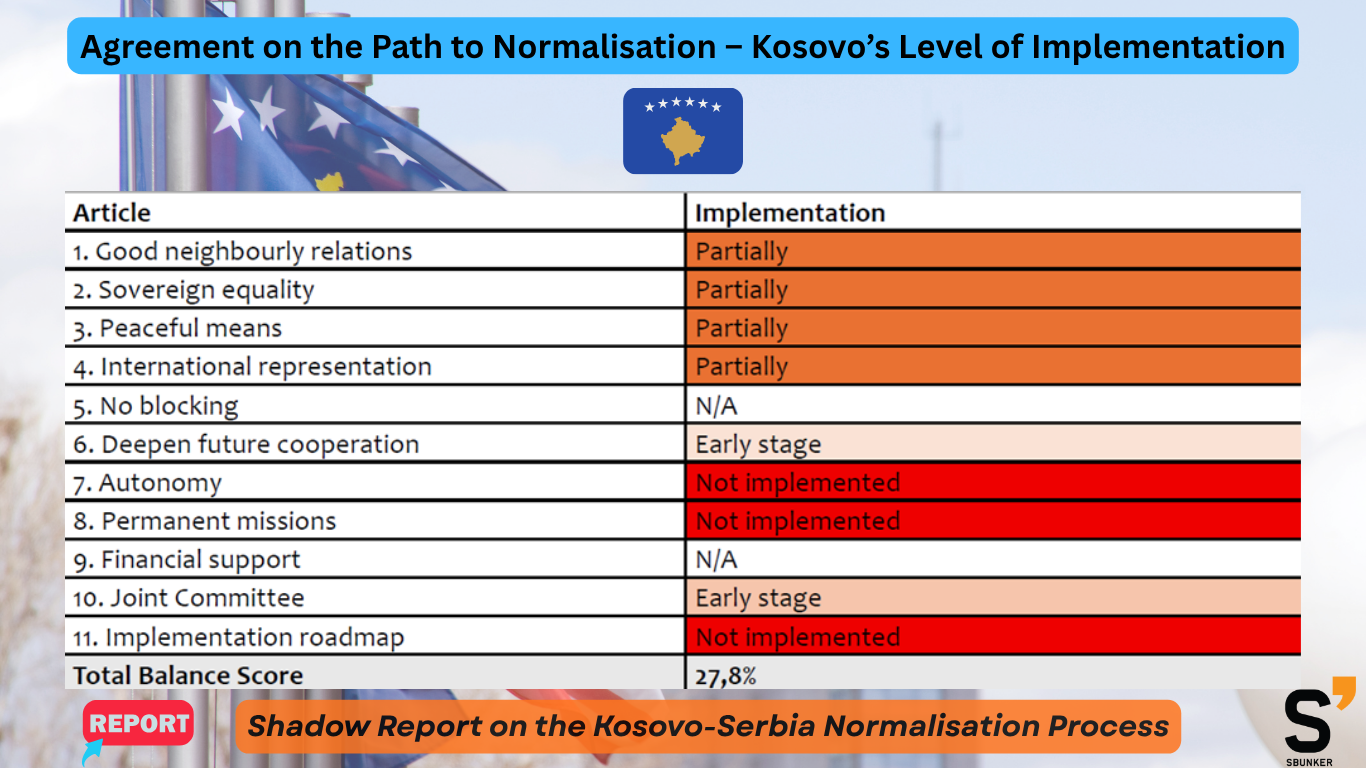
Kosovo’s implementation track record of the Brussels Agreement and the Ohrid Implementation Annex is mixed and uneven. In formal terms, Pristina has accepted the Agreement as part of the EU-facilitated dialogue framework and has continued to participate in dialogue meetings, the Joint Monitoring Committee format, and the missing persons track. It has also implemented selected measures that can be interpreted as supporting the Agreement’s logic, including reciprocal recognition of vehicle-registration arrangements, implementation of the Constitutional Court judgment concerning the Visoki Dečani Monastery land and cooperation on the Declaration on Missing Persons. However, Kosovo has not taken the decisive step that the EU and several member states have treated as the first practical trigger of the implementation sequence: submitting the EU draft statute for the Association of Serb Majority Municipalities to the Constitutional Court.
As a result, Kosovo’s implementation is assessed as more advanced on procedural and technical points, but limited or absent on the politically central obligations concerning self-management, institutional arrangements and sequencing.
According to the experts, the conflict is rooted in fundamentally incompatible goals: “Serbia does not recognise Kosovo’s independence; Kosovo seeks full sovereignty”. This makes any sustainable compromise inherently difficult, but the situation has now gone beyond difficulty into political deadlock. ASM is considered an important and necessary step (as a prior commitment), but not a solution to deeper problems, especially interethnic mistrust. Additionally, there are concerns that it could even create new tensions or fears, depending on perceptions.
Full report: Shadow Report on the Kosovo-Serbia Normalisation Process
Author